How to Incorporate Gratitude into Your Morning Routine

How to incorporate gratitude into your morning routine comes down to one habit: naming a few specific things you're thankful for before the day's noise takes over. It won't manufacture money or events out of thin air, but it's a well-studied way to nudge your mood, focus, and follow-through in a better direction before you've even left the bedroom.
What Gratitude Practice Actually Does
Gratitude here just means noticing and naming the good things already in your life, on purpose, instead of letting your attention default to what's wrong or missing. That's not a minor distinction. Researchers at UC Berkeley's Greater Good Science Center report that people who practice gratitude consistently report fewer symptoms of illness, including depression, along with more optimism, happiness, and stronger relationships. This is a mindset and behavior-change tool, not a way to conjure outcomes. It works by shifting what you pay attention to, which changes how you feel and what you do next.
Why Mornings Specifically
Your first 10-15 minutes awake set the attentional lens for the next several hours. Reach for your phone first and you're primed by whatever notification, headline, or comparison hits your feed. Reach for three specific gratitudes first and you're primed by your own life instead. Neither guarantees a good day, but the second one gives you a better starting point, and it's a habit you fully control.
There's also a built-in headwind worth naming: your brain isn't neutral. Psychologist John Cacioppo's research found that the brain reacts more strongly, with a bigger surge in electrical activity, to stimuli it registers as negative than to equivalent positive stimuli, a survival-oriented wiring pattern often called negativity bias. Practicing gratitude doesn't erase that bias. It's a deliberate counterweight to it, which is exactly why it takes repetition, not one good morning, to feel like it's working.
The Core Practice: A Specific Gratitude List
The single best-supported version of this habit is short and specific, not long and vague. In a controlled study by psychologists Robert Emmons and Michael McCullough, college students who kept a weekly gratitude list reported fewer physical symptoms, exercised more, and rated their overall life satisfaction higher than students who logged daily hassles or neutral events instead. The gratitude group wasn't doing anything elaborate: they were writing down a handful of things they were grateful for, on a regular schedule.
How to Do It
- Set a timer for 2 minutes. This is not a journaling session; it's a quick, repeatable habit. Longer sessions are fine later, but a 2-minute floor means you'll actually do it on rushed mornings.
- Write down three things, not one. Three is enough to force you past the first, most obvious answer ("my family") into something more specific.
- Name specifics, not categories. "My coworker covered my shift Tuesday without me having to ask" holds up better over time than "my job." Specific entries are easier to recall and re-feel later; vague ones blur together.
- Vary what you write about. If every entry is about the same person or thing, you'll run dry within a week. Rotate across people, small conveniences, your body, past problems that resolved, and simple sensory things (hot coffee, a quiet house).
Building It Into a Routine You'll Keep
Anchor It to Something You Already Do
Don't add gratitude as a new, standalone step. Attach it to a habit that's already automatic, like your coffee brewing, your toothbrushing, or the first few minutes after your alarm. "After I start the coffee maker, I write three gratitudes" is far more durable than "I'll do gratitude sometime in the morning."
Keep the Barrier Low
A sticky note pad by the coffee maker or a single recurring note on your phone beats an elaborate journal system you'll abandon in two weeks. If the practice requires finding a special notebook, a pen, and quiet, uninterrupted time, it will get skipped on your busiest mornings, which are often the mornings you'd benefit from it most.
If You Live With Others
A 60-second round of "one thing I'm grateful for" at the breakfast table or in the car works the same mechanism for kids or a partner, with the side benefit of modeling the habit instead of just describing it.
Pair It With Movement, Not Instead of Journaling
If you walk, stretch, or do a short workout in the morning, use part of that time to mentally run through specifics rather than writing them down. It's a reasonable substitute on days you're short on time, not an upgrade over writing, since writing forces more specificity than thinking alone.
What Gets in the Way, and What Actually Helps
"I don't have time."
Start at 2 minutes and three items. If that's still too much some mornings, drop to one item, but don't drop to zero. Consistency at a small dose beats an ambitious version you do twice and quit.
"I run out of things to say."
This is common by day 10-14 if you're only naming big-picture things. Rotate categories deliberately: a person, a small physical comfort, something that went right at work, a problem from last month that resolved itself, something about your own body or effort. Specificity, not novelty, is what keeps entries from feeling repetitive.
"It feels fake when I'm actually having a bad week."
Skip the forced positivity. Gratitude practice works better alongside honest acknowledgment of what's hard, not as a replacement for it. Naming one real, specific good thing during a rough stretch is more useful than performing enthusiasm you don't feel, and it's more sustainable long-term.
What This Practice Will and Won't Do
It will: sharpen your attention toward what's already working in your life, give you a repeatable few minutes that tend to improve mood and outlook, and, per the research above, correlate with better reported physical symptoms and life satisfaction when done consistently over weeks.
It won't: guarantee a good day, attract specific outcomes, replace treatment for depression or anxiety, or fix a genuinely difficult circumstance. Treat it as a mindset tool that supports how you show up, not a mechanism that changes what happens to you.
FAQ
How long before I notice a difference?
Most people report a mood shift within days, but the more durable effects (better sleep, fewer stress symptoms, steadier outlook) tend to show up over several weeks of near-daily practice, consistent with the multi-week designs used in the gratitude research cited above.
Journal, jar, or app: does the format matter?
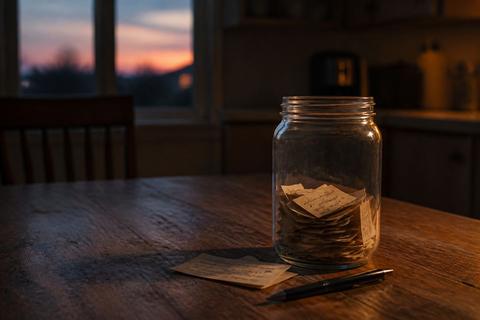
Not much. What matters is specificity and consistency. Pick whichever format you'll actually repeat tomorrow.
Can I do this at night instead of in the morning?
Yes. Morning sets your attentional tone for the day ahead, which is the advantage covered here, but an evening practice is equally well-supported and some people find it easier to sustain. Use whichever slot you won't skip.
Is there a "wrong" way to do this?
The main failure modes are vagueness (repeating "family, health, job" on autopilot) and over-scoping (starting with a 20-minute journaling ritual you can't sustain). Keep it short, specific, and repeatable.
Sources
- UC Berkeley Greater Good Science Center - Expanding the Science and Practice of Gratitude
- Emmons & McCullough (2003), "Counting Blessings Versus Burdens," Journal of Personality and Social Psychology (hosted by UC Berkeley Greater Good Science Center)
- Psychology Today - "Our Brains, Negative Bias" (citing John Cacioppo research)