
Boosting Creativity with Music: Playlists for Inspiration
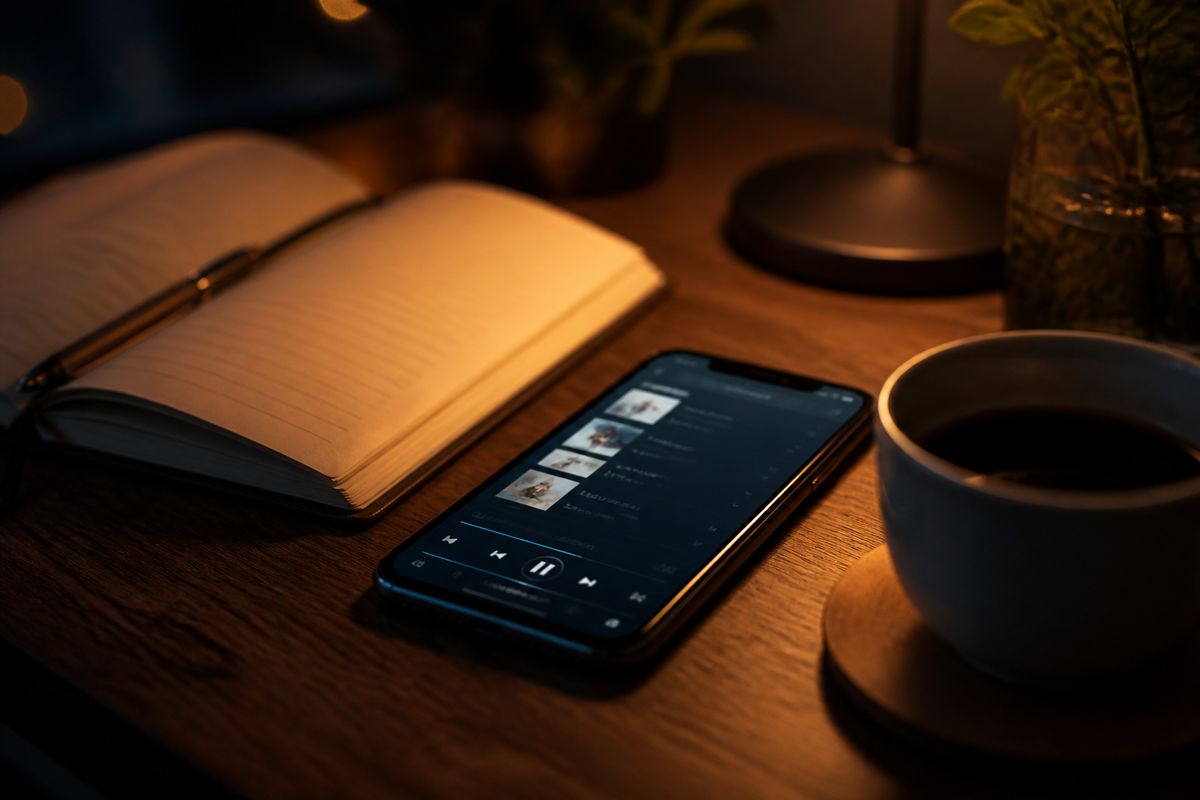
Boosting creativity with music isn't just something artists have always claimed, it shows up in controlled experiments too, though not in the way most playlists advertise. Music changes your mood, your arousal level, and how much competes for your attention, and those three things affect how many ideas you generate and how loosely you connect them. It won't hand you talent or a finished draft, but used deliberately, it's a cheap, repeatable way to shift into a more generative headspace for the right kind of task.
What Music Actually Changes During Creative Work
Creativity researchers split creative thinking into two modes: divergent thinking (generating many possible ideas or solutions) and convergent thinking (narrowing down to one correct or best answer). This distinction matters because music does not affect them the same way.
Mood: Upbeat Music Helps You Generate More Ideas
A 2017 study out of Radboud University had participants listen to calm, happy, sad, or anxious music, or sit in silence, before doing creativity tasks. The group that heard happy, high-arousal classical music (Vivaldi's "Spring" was one of the tracks used) scored meaningfully higher on divergent thinking, the Alternative Uses Task, where you list as many uses as you can for an everyday object, than the silence group: a mean score of 93.87 versus 76.10, a moderate and statistically significant effect (Ritter & Ferguson, 2017, PLOS ONE). The same study found no benefit of any music condition on convergent thinking, like picking the single best idea from a set or solving a puzzle with one correct answer.
Practical takeaway: reach for upbeat, positive-mood music when you're brainstorming or generating options. Switch to something quieter, or off entirely, once you're editing or making a final decision, since that is where the research stops showing a benefit.
Attention: Lyrics Are the Variable That Actually Hurts You
Not all "music while you work" advice holds up the same way. A 2022 systematic review covering 95 studies and 154 experiments across memory, language, reasoning, and attention tasks found a general detrimental effect of background music on memory and language-related tasks, with lyrical background music consistently more harmful than instrumental background music on the same tasks (Cheah, Wong, Spitzer & Coutinho, 2022, Music & Science). The same review found harder tasks were more vulnerable to music interference than easy ones, and that people with more introverted personalities showed a bigger performance drop from background music than extroverts did.
So genre matters less than whether words are competing with the words already forming in your head. If your task involves writing, editing, or close reading, instrumental music is the safer choice. Save vocal tracks for tasks that don't route through language, physical craft work, sketching, tidying a workspace, or the warm-up stretch before you actually sit down to write.
Playlists by Creative Task
These aren't mood boards. Each one is built around what the task actually needs from your attention, not just a vibe.
1. Writing and Drafting: Instrumental, Minimal Lyrics
Anything with words competes with the words you're trying to produce. Aim for instrumental tracks in the roughly 60-90 BPM range so tempo doesn't rush your sentences.
Starting points:
- "Weightless" – Marconi Union
- "Nuvole Bianche" – Ludovico Einaudi
- "River Flows in You" – Yiruma
Search "solo piano," "post-rock instrumental," or "lo-fi beats" – all three genres are built around minimal or absent vocals, which is the trait that actually matters here.
2. Visual Art: Textured, Ambient Soundscapes
Painting and drawing tolerate more sonic complexity than writing does, since you aren't processing language while you work. Ambient and world-music tracks with layered texture can support longer, looser sessions without the same lyric penalty.
Starting points:
- "The Great Gig in the Sky" – Pink Floyd
- "Awake" – Tycho
- "Breathe" – Télépopmusik
3. Design Work: Upbeat for Ideation, Quiet for Execution
Design mixes brainstorming (divergent) with hands-on execution (convergent), so match the music to the half of the task you're actually doing. Energetic, moderate-tempo tracks during the ideation stretch; instrumental and quieter once you're refining a specific layout or interface.
Starting points:
- "Can't Stop" – Red Hot Chili Peppers
- "Wake Me Up" – Avicii
- "Good Life" – OneRepublic
4. Planning and Pitching: Anthems Are a Warm-Up Tool, Not a Work Soundtrack
Motivational, high-energy tracks are genuinely useful for the few minutes before you sit down to plan or pitch something, since the mood lift can prime more flexible thinking going in. Keep them out of the room once you're actually writing the plan or making the final call, where lyrics and high arousal are more likely to pull focus than help it.
Starting points:
- "Stronger" – Kanye West
- "Don't Stop Believin'" – Journey
- "Eye of the Tiger" – Survivor
Building Your Own Playlist Instead of Borrowing One
Genre suggestions are a starting point, not a rule. Three adjustments matter more than the exact songs on the list:
- Match tempo to the task, not your current mood. A slow, stuck session doesn't always need slow music – sometimes a faster track is what breaks the rut. Test both instead of assuming.
- Drop lyrics for anything language-based. Writing, editing, and reading-heavy research go better with instrumental tracks, per the attention research above.
- Rebuild the list every few weeks. Once a song becomes background noise you've stopped consciously hearing, it stops producing much of a mood shift. A playlist that feels flat is usually just overplayed.
When Silence Beats Any Playlist
Music is not always the answer. When you're solving one specific, well-defined problem (the convergent-thinking case from the research above) or the task is genuinely difficult, silence or very low ambient noise tends to outperform music, upbeat or otherwise. If you notice yourself skipping tracks repeatedly or losing your place mid-sentence, that's the signal to turn it off rather than switch playlists.
What Music Can't Do
It's worth being direct about the limits here. Music does not install a skill, a body of knowledge, or expertise you don't already have, and it won't fix a project that's stuck because of an unclear brief or missing research. The divergent-thinking boost from mood-lifting music is real but modest in controlled testing, not a switch that turns a blank page into a finished piece. Treat it as one input among several: sleep, workload, deadline pressure, and how well-defined the task is will generally matter more than which playlist is running.
FAQ
Does music actually make you more creative, or does it just feel that way?
Both, depending on the task. For idea generation (divergent thinking), the mood lift from upbeat music produces a measurable, published effect. For tasks with one correct answer (convergent thinking), the same research found no benefit, so the "feels more creative" sensation doesn't reliably translate into better output on every kind of work.
Does classical music make you smarter on its own?
No. The often-cited "Mozart effect" on general intelligence has not held up well under replication. What the research above supports is narrower: positive-mood, higher-arousal music can boost idea generation in the short term, and that benefit doesn't extend to tasks with a single correct answer.
Is lo-fi better than other genres for focus?
Its main advantage is structural: minimal or no lyrics and a steady, unobtrusive tempo. Any instrumental genre with those two traits (ambient, solo piano, post-rock, some jazz) should work similarly. The genre label matters less than whether it has words.
What if I've always worked well with music and this seems to contradict my own experience?
Individual differences are real. Some people concentrate better with familiar sound in the background and some need silence, and personality plays a role, the research above found more introverted listeners lost more performance to background music than extroverted listeners did. Track your own results (did you finish more, or just feel busier?) alongside these general patterns rather than discarding either one.