Exploring the Link Between Gratitude and Resilience

Exploring the link between gratitude and resilience starts with a simple question: does noticing what's going well actually change how you handle what's going wrong? The research says yes, but not by magic. Gratitude practice does not remove hardship. It changes how your attention and your relationships work while you're in it, and that has measurable effects on stress and recovery.
What Gratitude Actually Is
Gratitude is the act of noticing and naming something good and, where relevant, who or what caused it. Researchers usually split it into two forms:
- State gratitude: a short-lived feeling triggered by a specific event, like someone covering your shift or a stranger holding a door.
- Trait gratitude: a more consistent habit of noticing good things across situations, built through repeated practice rather than luck.
The distinction matters because trait gratitude is the one tied to durable outcomes. A single thank-you note might lift your mood for an afternoon. A regular gratitude practice is what shows up in studies on stress, sleep, and depression symptoms months later.
What Resilience Actually Is
Resilience is the capacity to keep functioning, and eventually recover, after stress, loss, or setback. It's not toughness or the absence of pain. People who cope well after hard events typically share a few traits:
- Emotional awareness: naming what you're feeling instead of being run by it.
- Realistic optimism: expecting that things can improve, without denying the current difficulty.
- Social support: having people to call on, and being willing to call on them.
- Problem-solving: breaking a bad situation into next actions instead of freezing.
None of these are fixed personality traits. They're built through repetition, which is exactly why a practice like gratitude journaling can move the needle over weeks, not overnight.
How Gratitude and Resilience Connect
Gratitude lowers the stress baseline
Practicing gratitude regularly does not stop stressful things from happening, but it changes the emotional baseline you're working from when they do. According to research summarized by UC Berkeley's Greater Good Science Center, gratitude is linked to stronger relationships, better mental and physical health, and greater resilience in the face of adversity. That's a correlational picture built from many studies, not a guarantee for any one person, but it's consistent enough to take seriously.
Positive emotions widen your options under pressure
Psychologist Barbara Fredrickson's broaden-and-build theory offers a mechanism for why this works. The theory holds that positive emotions momentarily broaden a person's attention and range of possible actions, and that this broadened state helps build lasting resources: social bonds, coping skills, even physical health. Fredrickson's own research review states that positive emotions "broaden people's momentary thought-action repertoires and build their enduring personal resources, ranging from physical and intellectual resources to social and psychological resources," a pattern documented in her peer-reviewed synthesis of the theory. In plain terms: when you're not narrowed by fear or anger, you notice more options and think more flexibly, which is exactly what's needed when a problem shows up.
Gratitude strengthens the support you'll need later
Resilience rarely happens alone. Expressing genuine thanks to the people around you, a text, a specific compliment, a handwritten note, makes them more likely to stay engaged and to show up again when you need help. This is one reason gratitude and social support tend to move together in the research cited above: the habit doesn't just make you feel better, it maintains the relationships you'll actually lean on during a hard stretch.
Gratitude supports (but does not replace) reframing
Grateful people are not simply "positive thinkers." The useful version of this is cognitive reframing: after a setback, deliberately identifying what, if anything, you learned or what still went right. This is a specific skill, not a mood. It works best when it's honest. Forcing gratitude for something genuinely bad tends to backfire; the goal is finding what's real, not performing positivity.
How to Practice Gratitude in a Way That Builds Resilience
1. Keep a short, specific gratitude log
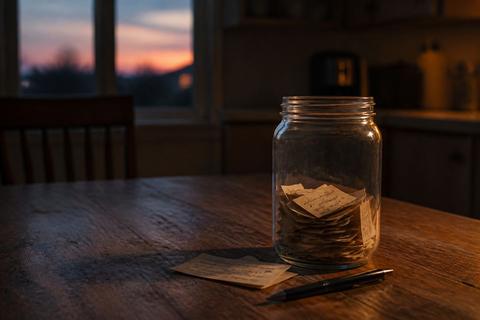
Each evening, write down three things that went well that day and, for at least one of them, why it happened. Specificity is what makes this work, "my coworker covered a call so I could pick up my kid" does more than "I'm grateful for my job." In the original clinical trial behind this exercise, participants who did this for seven consecutive nights reported measurably higher happiness at one week, with the effect still present at the six-month follow-up, according to the Greater Good in Action program at UC Berkeley. You don't need an elaborate journal. A notes app or index card works.
2. Say the thanks out loud or in writing, not just in your head
Tell the specific person what they did and how it affected you: "Thanks for staying late, it meant I didn't have to reschedule the whole week." This does double duty: it reinforces your own noticing, and it strengthens the relationship you may need to draw on later.
3. Pair gratitude with five minutes of quiet attention
A short daily practice, sitting with your breath, a slow walk without your phone, works because it trains you to notice what's actually happening instead of running on autopilot. You don't need 30 minutes; five focused minutes a day is enough to start noticing more of what you'd otherwise miss, including things worth being grateful for.
4. Reframe setbacks with one honest sentence
After something goes wrong, write one sentence answering: "What's one true thing that's still okay, or one thing this taught me?" If nothing fits, don't force it. Some days the honest answer is "nothing yet," and that's fine. The goal is accuracy, not forced positivity.
5. Maintain two or three people you can actually call
Resilience research consistently points to relationships, not self-reliance, as the bigger lever. Make a short list of two or three people you'd actually contact if things got hard, and make sure at least one of them knows you appreciate them, this month, not someday.
6. Log wins you'd normally skip past
Once a week, write down one thing you handled better than you would have a year ago. This isn't about ego. It's building a concrete record you can point to on a bad day, which is more useful than a vague sense that "things used to be worse."
What This Practice Does Not Do
Gratitude journaling is not a treatment for clinical depression, anxiety disorders, or trauma, and it will not resolve a genuinely unsafe or abusive situation. If you're dealing with persistent low mood, panic, or a crisis, a licensed therapist or your doctor is the right next step, not a journal. Gratitude and reframing are supportive habits that can improve day-to-day mood and coping capacity; they work alongside professional care, not instead of it.
FAQ
How long before gratitude journaling affects resilience?
Most studies measure effects over one to ten weeks of consistent practice, with mood benefits showing up within the first week and some effects persisting months later. A single entry won't do much; the benefit comes from repetition.
Is there such a thing as too much gratitude journaling?
Doing it once a day is enough for most people. Some research on repeatedly journaling about the same events found diminishing returns, so mix up what you write about rather than repeating the same three items every day.
What if I can't think of anything to be grateful for?
Start smaller than you think you need to: a warm shower, a text back from a friend, a parking spot. The exercise is about training attention, not finding something extraordinary.
Does gratitude journaling work if I'm skeptical about it?
The studies behind these exercises did not screen for believers. The effects showed up in general participant samples, so skepticism alone doesn't appear to block the benefit, though genuinely going through the motions without engaging probably reduces it.