How to Create a Dedicated Space for Nurturing Creativity
How to create a dedicated space for nurturing creativity comes down to a few concrete choices: where the space sits, what cues you build into it, and how consistently you use it. A messy corner of a shared room won't stop you from ever making art, but a set-up space measurably lowers the friction between "I have an idea" and "I actually sat down and worked on it." Here's how to build one that holds up after the first week of enthusiasm fades.
Why the space itself matters
Three things happen when you give creative work a fixed physical spot instead of doing it wherever you happen to be sitting.
- Less competition for attention. Researchers at Princeton University's Neuroscience Institute used fMRI to show that visual clutter competes with task-relevant objects for representation in the visual cortex, so a busier scene leaves less processing capacity for the task itself. A desk covered in unrelated mail, dishes, or cables is quietly taxing your focus before you've written a word.
- A cue your brain learns to associate with work. Habits form around consistent context, not willpower. In a widely cited University College London study of 96 people building a new daily habit, researchers found it took an average of 66 days for a behavior to become automatic, and that repeating it in the same situation each time was what made it stick. A dedicated chair, desk, or corner is that "same situation", it's doing the reminding so you don't have to.
- Fewer decisions before you start. If your supplies, sketchbook, or instrument are already out and ready, you skip the setup time that gives your brain a chance to talk you out of starting.
Choosing the location
Natural light, if you can get it
Put your space near a window if the room allows it. A 2014 study of office workers published in the Journal of Clinical Sleep Medicine, covered by Northwestern University, found that employees with windows received 173% more white light exposure during the workday and slept an average of 46 minutes more per night than employees without windows, and poor sleep is one of the most reliable ways to blunt attention and mood the next day. You don't need a sunroom; a desk angled toward a window is enough to get meaningfully more daylight than a windowless corner.
A spot with fewer interruptions
Pick the quietest room you have access to, and don't fight your household's actual habits. If the living room gets walked through fifteen times a day, it's not a creative studio no matter how you decorate it. Closets and basement corners work fine once you've cleared and lit them; what fails is a "flex space" that everyone else also uses for something else.
Somewhere you'll actually walk to
If reaching your space means moving boxes or hauling out folding furniture, you've added a barrier that outweighs almost any other design choice. A few seconds of friction is often the difference between a 20-minute session happening and not happening.
Setting up the physical space
Comfort you can sit in for an hour
A chair and desk at a height that doesn't strain your neck or wrists matters more than how they look. If you're doing seated work, writing, drawing, digital art, an adjustable chair and a surface at roughly elbow height will keep you working longer before discomfort ends the session for you.
Lighting for the actual task, not just ambiance
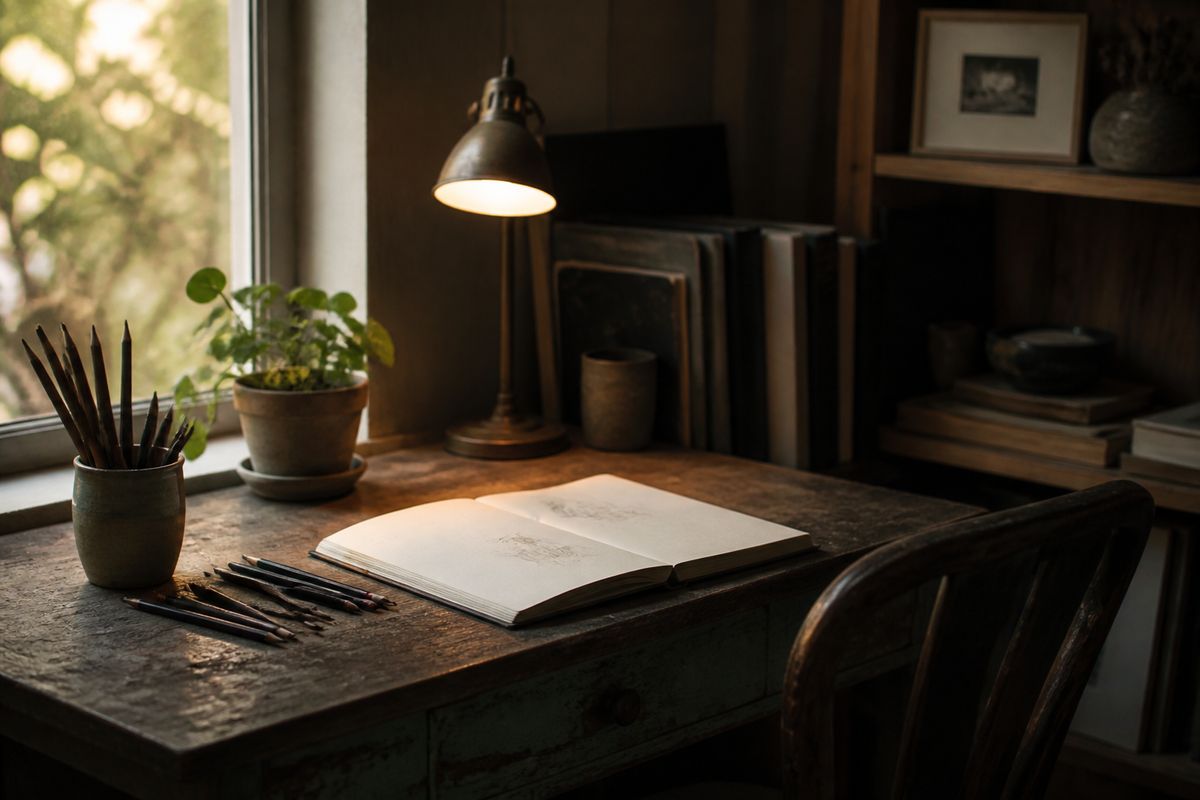
Layer at least two light sources: a focused task light (a desk lamp aimed at your work surface) for close detail work, and a softer ambient source for everything else. Relying on one dim overhead fixture is the most common lighting mistake in home creative spaces, enough to see by, not enough to work under for long without eye strain.
A place for supplies that isn't your work surface
Keep a shelf, bin, or drawer near the space so tools have a home that isn't "wherever there's room on the desk." This is the practical version of the clutter research above: fewer stray objects in your field of view while you're working.
Adding things that actually help you start
A few personal objects, not a gallery
A photo, a found object, a piece of work you're proud of, one or two things that mean something to you do more than a wall of inspiration-board clippings, which can tip back into the clutter problem above.
A plant, if you're going to add greenery
Time in natural settings has been linked to improved mood and self-reported psychological restoration in controlled field studies, a pair of 2018 experiments with hiking groups found that mood and restoration scores improved measurably after time outdoors. That's evidence for spending real time in nature more than for a houseplant on your desk, but a plant is a low-effort way to bring some of that greenery into an otherwise hard-edged workspace, and it costs you nothing to try.
Tools already out and ready
Whatever you make with, sketchbook, guitar, laptop, camera gear, leave it visibly ready to pick up rather than packed away. The goal is reducing the number of steps between walking in and starting.
Turning the space into a routine
Fixed time blocks, not "whenever inspired"
Put a recurring block on your calendar, even 20 minutes, three times a week, and treat it like an appointment. Waiting for motivation is a slower, less reliable path to consistent output than showing up on a schedule regardless of how you feel that day.
Phones and notifications off, on purpose
Put your phone in another room or in airplane mode for the session. Switching your attention to check a notification costs you more re-focusing time than the interruption itself takes, and a dedicated space only protects your attention if you also protect it from your phone.
Build in real breaks
A five-minute stretch or walk every 45 to 60 minutes keeps a two-hour session productive instead of letting the last 40 minutes go unfocused. Breaks aren't a failure to concentrate, they're part of sustaining it.
Keeping the space working over time
- Reset it every few months. Rearrange furniture, swap out what's on the walls, clear anything that's drifted onto the desk. A space that never changes eventually stops registering as anything at all.
- Retire inspiration that's gone stale. If a print or photo has faded into background noise you no longer notice, take it down. It's occupying visual space without doing its job.
- Audit supplies for what you actually use. Tools you haven't touched in months are clutter with a better excuse. Box them up or pass them on.
FAQ
Do I need a whole room for this to work?
No. A corner, a closet with a shelf and a chair, or a section of a shared room works as long as it's consistently used for creative work and not repurposed daily for something else. Consistency of use matters more than square footage.
What if I only have time to work at night, with no natural light available?
Layered artificial lighting, a bright task lamp plus ambient light, is a reasonable substitute for the hours you're actually working. Natural light matters most for your sleep and daytime alertness generally, so getting outside earlier in the day still helps even if your creative sessions happen after dark.
How long before this space actually feels automatic to use?
Based on habit-formation research, expect somewhere around two months of consistent use before showing up there stops requiring conscious effort, though that timeline varies a lot from person to person. Missing the occasional day doesn't reset the process; an extended gap of a few weeks tends to.
Sources
- Princeton Alumni Weekly, reporting Princeton Neuroscience Institute fMRI research on visual clutter and attention
- University College London (UCL News), covering Phillippa Lally et al., European Journal of Social Psychology, 2009
- Northwestern University (Northwestern Now), covering research published in the Journal of Clinical Sleep Medicine, 2014
- PMC/Frontiers in Psychology, 2018 field studies on nature walks, mood, and restoration