
How to Make Journaling a Family Activity
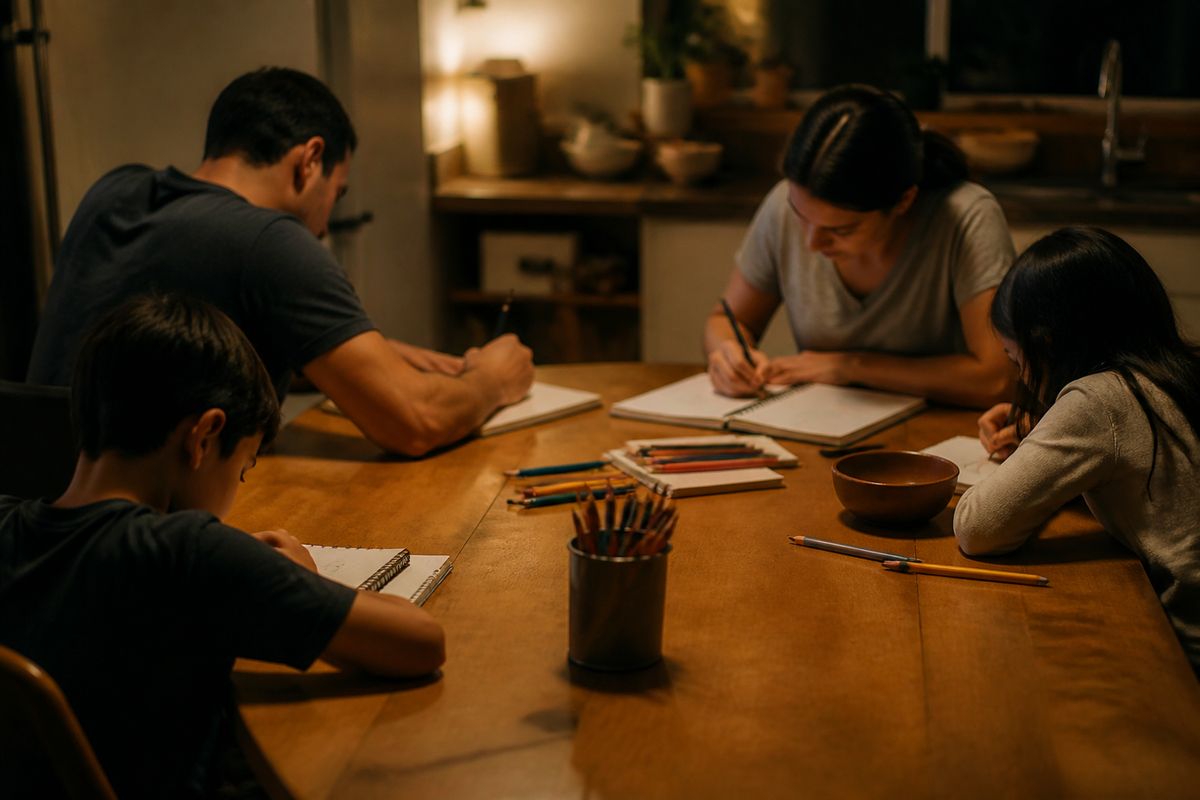
How to make journaling a family activity is mostly a scheduling and ground-rules problem, not a creativity problem: pick a short, repeatable slot, keep the writing low-pressure, and let sharing stay optional. Done that way, it works less like therapy and more like a family routine, and routines and shared rituals are one of the more consistently studied levers for family closeness and kids' behavior regulation.
What family journaling actually does (and doesn't)
Journaling together won't manufacture harmony or fix a rough patch between siblings on its own. What it can do is give a family a small, predictable block of shared attention, and predictable shared routines are linked to real outcomes. A review summarized by the American Psychological Association found that family routines and rituals are associated with marital satisfaction, adolescents' sense of personal identity, children's health, academic achievement, and stronger family relationships, and that young children are healthier and better behaviorally regulated when family life has predictable routines. Journaling together is one way to add a routine like that; it's not a special or magic version of one.
On the individual side, gratitude writing has its own separate research base. According to University of Rochester Medical Center, studies link a regular gratitude practice to reduced stress, improved mood, and better sleep. That's a claim about mood and stress regulation, not about journaling attracting good things into your life, treat it as a mindset tool, not a mechanism for changing what happens to you.
Set up a session that actually survives past week two
Pick a slot that's already protected
Attach journaling to a time slot that already exists rather than inventing a new one from scratch. Right after dinner, or 15 minutes before bedtime, works better than “Sunday afternoon, if we're free,” because free Sunday afternoons get eaten by errands. If a fixed weekly slot is more realistic for your household, three or four times a week for about 15 minutes is a reasonable target, roughly the same time commitment researchers point to for family meals, which is a comparable low-effort, high-repetition family ritual.
Keep the supply list short
One notebook per person, plus a shared box of pens, colored pencils, and stickers for younger kids. Skip anything that requires setup or cleanup (paints, glitter) or the barrier to starting goes up every single time. If a session requires more than two minutes of prep, it will get skipped on tired nights.
Write ground rules down, don't just assume them
Sharing is opt-in, every time. Ask “does anyone want to read something out?” instead of going around the table. Kids (and adults) censor themselves the moment sharing feels mandatory, which defeats the point.
No editing other people's entries. No fixing a kid's grammar, no commenting on a partner's handwriting, no “you spelled that wrong.” This is the fastest way to make someone dread the next session.
Adults write too, in the same room, at the same time. A parent scrolling their phone while telling a eight-year-old to journal teaches the opposite lesson. Modeling the behavior does more than any prompt.
Formats that actually get used
The one-line gratitude round
Each person writes one specific thing from that day, not a category like “my family,” but a specific moment (“Mom let me pick the music in the car”). Specificity is what makes the entry worth rereading later; vague entries blur together and get skipped in a month.
The shared story notebook
One notebook, passed around. Each person adds two or three sentences continuing a story the last person started. This works well for kids age six and up who find a blank page intimidating, a story format gives them a job (continue the plot) instead of an open prompt (write your feelings), which is a lower bar to clear.
The question-of-the-week card
Write one question on an index card at the start of the week: “What's something you got better at this week?” or “What almost ruined your day, and what saved it?” Everyone answers the same question in their own notebook, then compares answers at the end of the week. This gives structure without forcing anyone to generate their own topic from scratch, which is where most journaling habits stall.
Draw-first for younger kids
Kids under seven or eight often find drawing a feeling easier than describing it in words. Let them draw first and add one sentence underneath, even if an adult has to write it for them as dictation. Don't require a paragraph from a child who isn't there developmentally yet, that turns the activity into a chore instead of a habit.
What to avoid
Don't use family journaling time to process an active conflict, a recent loss, or acute anxiety, sit down with a therapist or counselor for that instead. Regular reflective writing about ordinary days is a different activity from expressive writing about trauma or intense distress, and research on the latter has actually shown mixed and sometimes negative results in children specifically, unlike in adults. Keep the family session light: daily highlights, gratitude, stories, silly questions. If a session turns into someone processing something heavy, follow their lead, but don't engineer the activity to go there on purpose.
Also don't turn sharing into a performance review. If a kid's entry is three words, that's a complete entry. The goal is consistency of the routine, not depth on any single day.
Making it stick past the first month
Attach it to an existing cue
“After we clear the table” or “before the bedtime story” works better than a calendar reminder, because it rides on something that's already habitual instead of competing with a new alarm every day.
Let interest dip without quitting
Expect some weeks where one or two family members are checked out. That's normal for any recurring family activity, not a sign it's failed. Keep the session short enough (10 to 15 minutes) that a low-energy week is still tolerable rather than dreaded.
Revisit old entries a few times a year
Once a season, pull out notebooks from six months back and read a few entries aloud. This is usually the moment kids get genuinely invested, hearing what past-them wrote is more compelling than the act of writing itself, and it's a good hook for keeping teenagers willing to participate past the point where the novelty alone wears off.
FAQ
What age can kids start?
As soon as they can hold a crayon and dictate a sentence, generally around age four or five, using drawing plus adult-transcribed dictation. Independent writing usually becomes realistic around six to eight, depending on the child.
How long should a family journaling session be?
10 to 15 minutes is enough for most formats above. Longer sessions are more likely to get skipped on busy nights; short and consistent beats long and sporadic.
Should teenagers be forced to participate?
No. Invite them, let them write privately without reading it out, and don't make participation mandatory. Teens are far more likely to stay involved if their entries are guaranteed private than if sharing is expected.
What if one family member refuses every time?
Let them sit with a notebook without pressure to write anything, or let them draw instead. Forcing the activity tends to build resentment toward it; presence without output is still a fine outcome for a session or two.