How to Practice Daily Gratitude for Happiness

Practicing daily gratitude for happiness does not mean forcing yourself to feel cheerful about a bad day. It means deliberately noticing specific good things you'd otherwise scroll past, on a regular schedule, until doing so becomes automatic. The habit is simple, but "simple" and "easy to stick with" are different things, most people quit a gratitude journal within a couple of weeks. Here's what actually works, what the research supports, and what it doesn't.
What gratitude practice does and does not do
Does: a controlled 10-week study by psychologists Robert Emmons and Michael McCullough found that people who wrote a few sentences a week about things they were grateful for felt more optimistic about their lives, exercised more, and had fewer visits to the doctor than a group who wrote about daily irritations instead (Harvard Health). Separately, a 2023 systematic review and meta-analysis of 64 randomized controlled trials found gratitude interventions produced small but statistically significant gains in life satisfaction and mental health, plus measurable drops in anxiety and depression scores (PMC systematic review).
Does not: that same review flagged the evidence as low-to-very-low certainty by GRADE standards, with high risk of bias across most trials and effect sizes described by the authors as small compared to treatments like medication. Gratitude journaling is a low-cost mood and outlook tool, not a substitute for therapy or medical care, and it will not erase clinical depression or anxiety on its own.
How to build the habit
1. Write three specific things, most days, for at least two weeks
The format that shows up in the research is short and specific: three to five things you're grateful for, written in a sentence or two each, most days of the week. Specificity is what separates a real entry from a placeholder one.
- Weak: "I'm grateful for my family."
- Specific: "I'm grateful my sister called to check on me before my interview."
Two weeks is roughly the point where people either have a habit or have quietly stopped. Pick a fixed time, right after you brush your teeth, or with your morning coffee, so it doesn't depend on remembering.
2. Use a same-time anchor, not an open-ended "whenever"
Pick one moment already built into your day: right before bed, right after your alarm, or during a commute if you're not driving. Attaching a new habit to an existing routine is a well-documented way to make it stick, rather than relying on willpower each day.
3. Try a gratitude jar for the long view
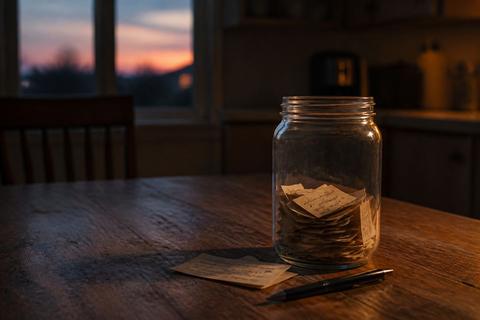
Keep a jar or small box on a shelf. When something good happens, write one line on a slip of paper and drop it in. Read through the slips at the end of the year, or whenever you need perspective during a hard stretch. The jar works because it's a physical record you can't easily talk yourself out of, you wrote it down when it was true.
4. Say it out loud to someone, at least once a week
Telling another person what you appreciate about them does two things a private journal can't: it strengthens the relationship, and it forces you to be specific enough that the other person understands why. A text, a two-line email, or a comment in person all count. Aim for once a week rather than "someday."
5. Put gratitude before sleep, not just at random
A study of 401 adults by Wood, Joseph, Lloyd, and Atkins found that people higher in trait gratitude reported better subjective sleep quality, longer sleep duration, and less time spent lying awake, and the effect was explained by having more positive and fewer negative thoughts right before falling asleep (Wood et al., Journal of Psychosomatic Research). Practically: spend the last two minutes before you put your phone down naming one thing that went right that day, instead of running through tomorrow's problems.
6. Pair it with two minutes of quiet breathing, if journaling alone isn't landing
If writing feels mechanical, try this instead:
- Sit somewhere quiet for two minutes.
- Breathe slowly, in for a count of four, out for a count of six.
- On each exhale, silently name one specific thing you're grateful for.
This isn't a separate "technique" so much as gratitude journaling without the pen, useful on days when you're too tired to write but still want the habit intact.
7. During a genuinely hard week, lower the bar
Gratitude practice is not about pretending a bad situation is good. On hard weeks, it's fine to write down something as small as "the heat worked" or "a coworker covered for me." The goal is keeping the habit alive, not producing profound entries. If a week is too heavy for even that, skip it and pick the habit back up rather than treating the gap as failure.
What to avoid
- Vague entries. "Grateful for today" every day for a month teaches your brain nothing new. Specificity is what drives the effect in the research above, not the act of writing itself.
- Turning it into another chore. If a nightly journal starts to feel like homework, switch to the two-minute breathing version or a weekly check-in instead of quitting entirely.
- Expecting it to fix external problems. Gratitude journaling changes your attention and mood; it is not a plan for a financial, health, or relationship problem. Pair it with concrete action on whatever's actually wrong.
FAQ
How long before I notice a difference?
Most of the research uses interventions lasting several weeks to a few months. Emmons and McCullough's participants reported feeling more optimistic after 10 weeks of weekly entries, treat two to three months of consistent practice as a reasonable test window, not two days.
Does gratitude journaling work for everyone?
Not uniformly. The 2023 meta-analysis found the average effect across 64 trials was real but small, and evidence quality was rated low to very low due to inconsistent study design. Some populations studied (for example, one commonly cited sample of divorced women) showed no measurable benefit. Treat it as a tool worth trying, not a guaranteed fix.
Is a gratitude journal a replacement for therapy?
No. It's a self-directed habit that can support mood and outlook alongside professional care, not instead of it, especially for clinical depression or anxiety.
What should I actually write, in practice?
Three specific sentences, most days: what happened, who or what was involved, and why it mattered to you in that moment. That level of detail is what the research behind this practice is actually measuring.