How to Use Journaling to Enhance Your Creative Flow

How to use journaling to enhance your creative flow comes down to a handful of specific habits, not vague inspiration. Journaling won't manufacture talent, but it clears the noise that keeps you from starting, and it gives you a record you can mine when you're stuck. Here's what actually works, backed by real research on writing and creativity.
Why Journaling Helps Creative Work
Journaling isn't a mystical ritual. It's a low-cost way to externalize thoughts so your brain stops looping on them. That has a few concrete payoffs:
It Frees Up Working Memory
When a half-finished idea, a worry about a deadline, or a nagging task sits in your head, it competes for the same mental resources you need for creative problem-solving. Writing it down gets it out of active memory and onto paper, which is why a quick brain dump before a work session often makes the actual work easier, not because the writing itself is magic.
It Surfaces Patterns You'd Otherwise Miss
A dated, ongoing journal lets you look back and notice things in the moment you can't: which projects you abandoned and why, what conditions were present the last time you had a genuinely productive week, which excuses keep recurring. That kind of pattern-spotting is hard to do in your head.
Unfiltered Writing Loosens Up Idea Generation
Timed, unedited writing (often called freewriting) works because you're temporarily turning off the internal editor that filters ideas before they're fully formed. A short freewriting session doesn't guarantee a breakthrough, but it reliably produces more raw material to work with than sitting and "trying to think of something."
Choosing a Journal That You'll Actually Use
The format matters less than whether you'll open it. A few practical factors:
Portability vs. Desk Journal
If your ideas hit while commuting, cooking, or walking, a small notebook you can carry (or a notes app) will get used. A larger desk journal works if your practice is a scheduled sit-down session.
Paper for the Medium You Actually Use
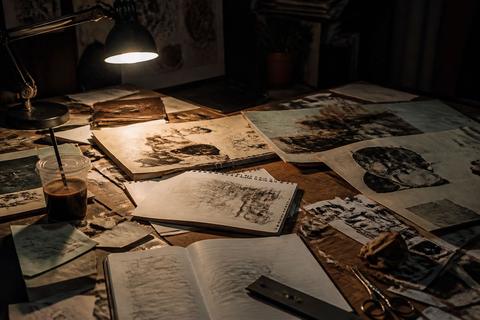
If you sketch, use thicker paper (100gsm or more) that won't bleed or warp with markers or light watercolor washes. If you only write, any notebook works. Don't buy a mixed-media journal if you never draw. It's an excuse to avoid writing in a "nice" book.
Binding
Spiral-bound notebooks lie flat and let you tear pages out without wrecking the binding. Hardcover journals hold up better if the book is going to live in a bag for months.
Five Journaling Techniques, With Steps
1. Freewriting
Set a timer for 10 minutes. Write continuously about whatever is in your head or about the specific project you're stuck on. Don't stop to fix spelling or grammar, and don't reread until the timer goes off. Most of what you write will be filler; that's expected. Afterward, scan the page and underline the one or two sentences that feel like an actual idea. Ten minutes is enough to get past the obvious first thoughts without turning into a chore you'll skip.
2. Mind Mapping
Write your central problem or theme in the middle of a blank page and circle it. Draw branches out to related ideas, then sub-branches off those. Don't worry about which branch is "correct." The value is in forcing connections between ideas that wouldn't naturally sit next to each other in a linear list.
3. Prompt-Based Entries
Keep a running list of 15-20 prompts related to your specific creative work (not generic ones). For a writer that might be "describe a place using only sound," for a designer "redesign this object for one-handed use." Give yourself 5-10 minutes per prompt, once or twice a week. Short and frequent beats long and rare here.
4. Gratitude Journaling
This one is about mood and focus, not idea generation directly, but a bad mood is one of the most reliable creativity killers. At the end of the day, write down three specific things you were grateful for, and note why. UC Berkeley's Greater Good Science Center reviewed the research and found that people who kept a gratitude journal 15 minutes a day, at least three times a week, for two weeks reported more positive mood, greater optimism, and better sleep. It's not going to hand you a plot twist, but a calmer, more optimistic baseline makes it easier to sit down and do the work.
5. Project Logs
For anything longer than a single session, run a separate log just for that project: what you tried, what didn't work, what you'll try next time. This does two things freeform journaling doesn't: it stops you from re-solving the same problem twice, and it gives you a written record of progress on days when it feels like you haven't moved at all.
Building the Habit So It Actually Sticks
The technique matters less than whether the habit survives past week two.
Anchor It to an Existing Routine
Attach journaling to something you already do without thinking, coffee in the morning, or shutting your laptop at the end of a work session, rather than trying to find a floating 15 minutes in an open schedule.
Keep It Physically Close
A journal in a drawer gets used less than one sitting open on the desk. Friction, even small friction, is enough to kill a habit that isn't yet automatic.
Write the Goal Down, Not Just the Entries
If you're using journaling to support a specific creative goal (finishing a draft, building a portfolio), write the goal itself down, not just your daily reflections on it. A study of 149 professionals by Dr. Gail Matthews at Dominican University found that people who wrote down their goals accomplished significantly more than those who only thought about them, and that people who additionally sent weekly progress updates to another person accomplished the most of all. The lesson for a solo creative practice: write the goal, and if you can, tell someone what you're working toward and check in with them periodically.
Lower the Bar for What Counts
A three-line entry still counts. Journaling only compounds if you keep doing it, and perfectionism about entry quality is one of the fastest ways to quit.
What Journaling Won't Do
It won't replace the actual practice of your craft; you still have to write the pages, make the art, or build the thing. It doesn't work as a substitute for skill-building, and there's no fixed number of days after which creativity is "unlocked." Treat it as a support habit that removes friction and clutter, not a technique that produces ideas on its own.
FAQ
How long should a creative journaling session be?
Ten to twenty minutes is enough for most techniques here. Freewriting and prompts work fine at 10 minutes; gratitude entries take less. Longer sessions aren't inherently better and are more likely to get skipped when you're busy.
What if I miss a few days?
Restart without a "catch-up" entry trying to cover what you missed. A journaling habit that requires perfect daily continuity is a habit that dies the first time life gets busy.
Do I need different journals for different techniques?
No. One notebook with dated entries works fine; label each entry by type (freewrite, gratitude, project log) if you want to scan back through it later.
Is typing as effective as handwriting?
For freewriting and project logs, typing is fine and often faster. For gratitude journaling specifically, some of the reviewed studies used handwritten or app-based formats interchangeably, so use whichever you'll actually keep up with.