
How to Use Nature as a Catalyst for Creative Inspiration
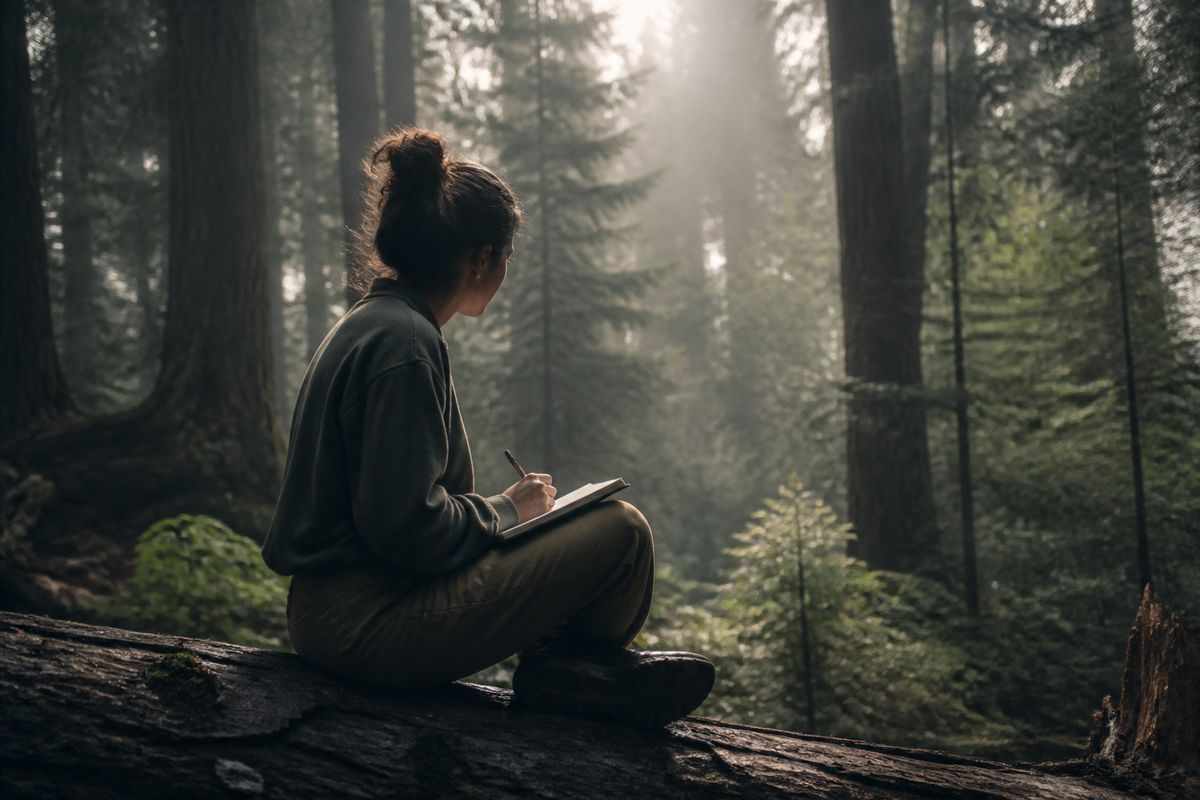
Using nature as a catalyst for creative inspiration works because it changes what your brain is doing, not because the outdoors contains some special spark. Time outside lowers the mental noise that crowds out new ideas, and that quieter state is where associative thinking (the kind that produces "aha" connections) tends to happen. Here is what the research actually supports, and how to use it on purpose instead of waiting for inspiration to show up.
What the Research Shows
The most cited evidence comes from a 2012 study of 56 adults on Outward Bound backpacking trips, published in PLOS ONE. Researchers gave a standard creative-reasoning test (the Remote Associates Test) to one group before their trip and to a second group on day four of the same trip, with no phones or screens allowed either way. The in-the-field group scored 50% higher on average (6.08 correct out of 10, versus 4.14 for the pre-trip group), a large effect by psychology standards (Atchley, Strayer & Atchley, 2012, PLOS ONE).
That study can't fully separate "nature" from "four days without a phone," and it measured a lab test of word association, not real-world creative output. But it lines up with decades of smaller studies under Attention Restoration Theory, which holds that natural settings let the brain's directed-attention system rest because looking at trees, water, or open sky takes very little conscious effort, unlike a screen or a to-do list. That rest is what seems to free up capacity for the kind of loose, associative thinking creative work depends on.
What This Does Not Mean
Nature does not hand you finished ideas, and a walk will not fix a deadline you've been avoiding for weeks. What the evidence supports is narrower and still useful: time outside can lower stress hormones, rest depleted attention, and put you in a mental state where existing ideas connect more easily. Treat it as a condition that makes creative thinking more likely, not a guaranteed trigger.
How to Use It
1. Put It on the Calendar, Not on Willpower
Twenty to thirty minutes outdoors, most days, is the range that shows up across the restoration-theory research as enough to matter. Pick a fixed time, before work, at lunch, right after you close the laptop, instead of waiting until you feel like it. A recurring slot on a specific route (a park loop, a block around the office) beats an open-ended "get outside more" intention because it removes the decision each day.
2. Leave the Phone Behind or in Airplane Mode
The backpacking study's subjects had zero device access for four straight days, which is the extreme version of the mechanism: it's not just the trees, it's the absence of notifications competing for attention. You don't need four days. Even a 20-minute walk with your phone silenced and pocketed will get you closer to the restorative effect than the same walk spent checking messages.
3. Engage Senses Deliberately Instead of Passively Looking
Passive scrolling through a park is not the same as active sensory attention. On a walk, spend a minute or two on each of the following instead of letting your mind default back to your inbox:
- Sight: pick one plant, cloud formation, or building detail and actually study its shape for 30 seconds.
- Sound: try to isolate three distinct sounds (wind, a bird, traffic) instead of hearing them as one blur.
- Touch: if it's appropriate, touch bark, water, or stone, texture engages a different part of attention than sight alone.
- Smell: cut grass, rain on pavement, and pine are all distinct triggers that tend to surface unrelated memories, which is often where a creative connection starts.
4. Carry a Notebook, Not Your Phone's Notes App
Write down whatever surfaces, a phrase, a half-formed idea, an observation, in a small notebook you keep for this purpose only. The point isn't the notebook itself; it's that transcribing by hand forces you to slow down and actually notice what you were thinking, rather than typing and moving on. Review these notes weekly; most of what you write outdoors will be unusable, and a handful of entries will turn into something you can actually use.
5. Bring Limited Nature Indoors When You Can't Get Outside
A 2007 Washington State University study of 96 participants found that working on a computer task in a room with live plants raised self-reported attentiveness by about 10% and produced faster reaction times than the same task in a plant-free room, with blood pressure also rising less over the course of the task (Lohr et al., Washington State University). That's a modest effect from a lab study, not a guarantee that a desk plant will fix a creative slump, but it's a legitimate reason to keep a couple of plants near where you work if getting outside isn't an option that day.
When You're Stuck on a Specific Project
Change Location Before You Change Approach
If you've been stuck on the same problem indoors for more than 30-45 minutes, that's a signal to step outside rather than push through. You're not looking for the answer to appear in the sky; you're interrupting a stress loop that's making you less flexible, not more.
Give the Walk a Loose Constraint
An unstructured walk is fine, but a walk with one small task, find five things that are the color blue, notice every sound for two minutes, photograph three textures, keeps your attention loosely occupied instead of spiraling back to the problem you're stuck on. That's often when the unrelated solution shows up.
Set a Real End Point
Decide before you leave your desk how long the break is (15 minutes, 30 minutes) and stick to it. Open-ended breaks tend to turn into avoidance; bounded ones tend to function as an actual reset.
FAQ
How much time in nature do I actually need?
Most of the supporting research clusters around 20-30 minutes for a noticeable attention-restoration effect, with stronger effects at multi-day exposure (as in the backpacking study). There's no evidence that more than roughly 30-50 minutes per session adds much extra benefit for a single outing.
Does looking at nature photos or videos work as a substitute?
Some restoration-theory research finds a smaller effect from nature imagery and video compared with being outside, so it's a reasonable fallback on a bad-weather day, not an equivalent replacement.
Do I need to go somewhere scenic, like a national park?
No. The Kaplans' original Attention Restoration Theory research, and most of the follow-up studies, used ordinary settings: campus greenery, neighborhood parks, tree-lined streets. A dramatic landscape isn't required for the mechanism to work.
Will this fix a long-term creative block?
Not by itself. A persistent block usually has causes beyond attention fatigue, skill gaps, unclear goals, fear of judgment, or simple burnout, and nature exposure won't resolve those. It's one tool for lowering mental noise, best combined with actually defining what you're trying to make and why.