The Impact of Collaboration on Creative Problem Solving
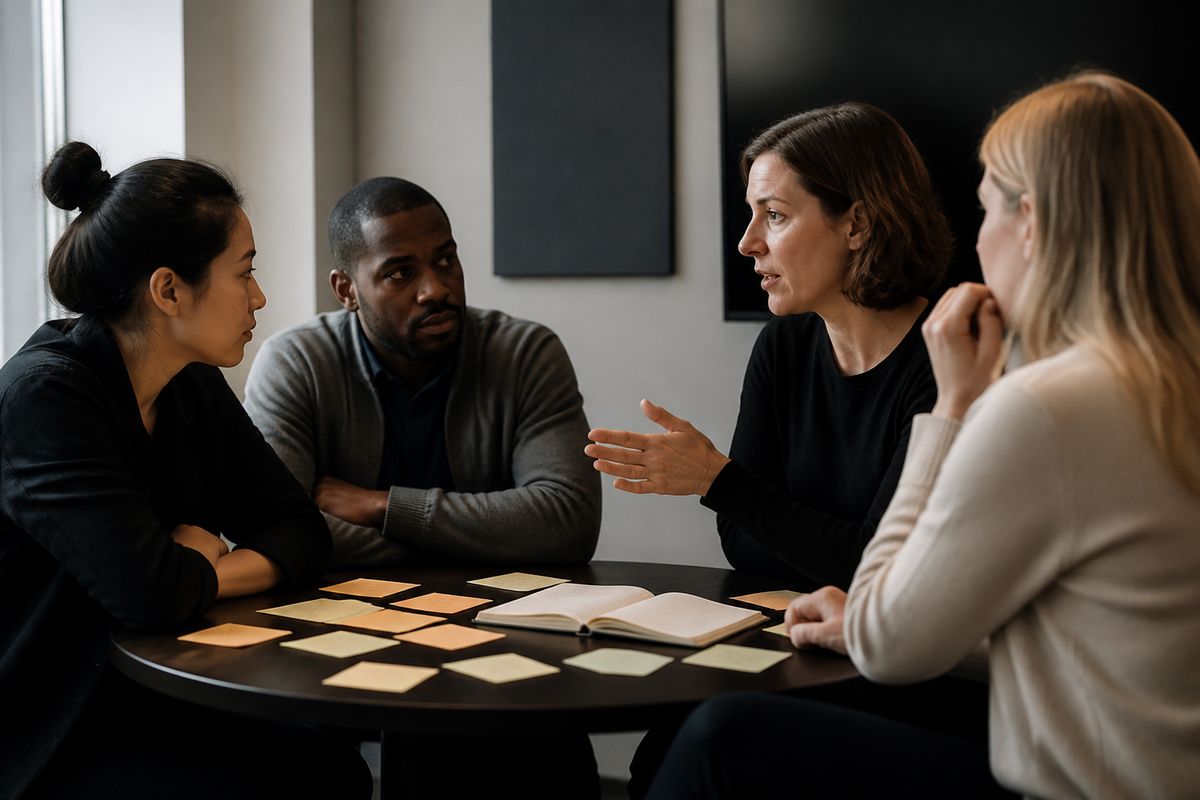
The impact of collaboration on creative problem solving shows up most clearly when a stuck problem gets handed to more than one mind: the group does not just add ideas together, it changes how the ideas get tested. A team of four with mixed backgrounds will surface options a single person would never think to check, and structured group work catches errors an individual would miss. But collaboration is not automatically better than solo work. The research shows it depends heavily on how the group is run.
What "creative problem solving" actually requires
Creative problem solving needs two different mental gears. Divergent thinking is the open phase: generating as many possible solutions as you can without judging them yet. Convergent thinking is the narrowing phase: comparing those options against constraints (cost, time, feasibility) and picking the strongest one. Most stalled projects are stuck in one gear: either not enough raw options were generated, or nobody ever narrowed them down to a decision.
Groups are genuinely useful for the divergent phase (more raw material, more angles) and for the convergent phase (more scrutiny before committing). They are not automatically better at either one. Group setup determines which way it goes.
Where collaboration actually helps
1. Diverse perspectives catch blind spots
A team mixing an engineer, a designer, and someone who talks to customers will flag different failure points in the same idea before it ships. The value isn't "more people," it's more different vantage points on the same problem: a group of five people with identical training and identical assumptions doesn't add much over one of them.
2. Group problem-solving ability is a measurable, separate trait
Group performance on problem-solving tasks isn't just a function of how smart the individual members are. Research from Carnegie Mellon and MIT researchers testing 699 people in small groups found a measurable "collective intelligence factor" that predicted how well a group would do across a wide range of tasks, and that factor correlated only weakly with the average or highest individual IQ in the group. What it correlated with instead: each member's social sensitivity (reading and responding to others accurately) and how evenly conversational turns were distributed. Groups where one or two people dominated the conversation scored lower, regardless of how smart those dominant members were (Woolley et al., 2010, published in Science).
The practical version: a group's problem-solving quality depends more on whether everyone gets airtime than on stacking the room with the highest IQs available.
3. Psychological safety is the actual lever, not "team spirit"
Google's multi-year internal study of what separates its highest- and lowest-performing teams (Project Aristotle, ~180 teams studied) found psychological safety (the shared belief that you can take an interpersonal risk, such as asking a "dumb" question, admitting a mistake, or proposing a weird idea, without being punished or embarrassed for it) was the single strongest predictor of team effectiveness, ranked above dependability, structure, or even how meaningful the work felt to members (Google re:Work, Understand Team Effectiveness). This builds on organizational-behavior researcher Amy Edmondson's earlier work defining the concept.
What this looks like in practice: a team lead who visibly says "I don't know, what does everyone think" and who responds to a wrong answer with a follow-up question instead of a correction, builds the condition where people actually offer their weirder, more useful ideas instead of the safe ones.
4. Shared workload sustains effort on hard problems
Creative problems that take weeks, not minutes, need sustained attention. Splitting the load across people who hold each other accountable to deadlines tends to keep a project moving past the point where a solo effort stalls out. This is a motivation and accountability effect, not a creativity effect on its own, but it's often the difference between an idea that gets explored fully and one that gets abandoned at the first obstacle.
Where collaboration backfires
Groupthink
Psychologist Irving Janis coined "groupthink" to describe what happens when a cohesive group's desire for agreement overrides honest evaluation of the options on the table. Members self-censor, dissent quietly disappears, and the group converges on a decision faster than the evidence actually supports (Janis, 1972, summarized via Simply Psychology). It shows up most in tight-knit teams with a strong, decisive leader and no explicit process for surfacing disagreement.
Fix: assign someone the explicit job of arguing the other side before the group finalizes a decision. A rotating "designated dissenter" role works better than hoping someone will volunteer to be the difficult one.
Production loss in group brainstorming
Live, spoken brainstorming sessions where people take turns pitching ideas out loud tend to generate fewer total ideas than the same number of people working alone and pooling their lists afterward. Waiting your turn to speak means you're not generating new ideas while someone else talks, and some ideas get forgotten before your turn comes. If the goal is maximum idea volume, have people write ideas independently first (5 to 10 minutes, silently), then combine and discuss as a group. Use the live group time for narrowing and building on ideas, not first-draft generation.
Time cost
Reaching group consensus takes longer than one person deciding alone. Scheduling, discussion, and disagreement all add real time. For a problem with a hard deadline and low stakes, a single competent person deciding fast can beat a slow group process. Save full collaborative sessions for problems where the stakes justify the extra hours.
How to structure collaboration so it actually works
- Separate divergent and convergent time. Generate ideas first (individually, then pooled), evaluate and narrow second. Mixing the two phases in one meeting kills half the ideas before they're fully formed.
- Cap group size for idea generation. Four to six people surfaces enough diversity of perspective without the airtime problem getting worse; larger groups need a facilitator actively managing turn-taking.
- Assign a dissenter. Rotate who is responsible for arguing against the leading idea before it's finalized.
- Write before you talk. Five to ten minutes of silent, individual idea-writing before group discussion consistently produces more (and more original) options than jumping straight into open discussion.
- Define roles up front. Who decides, who researches, who's accountable for follow-through: settling this before the work starts avoids the ambiguity that drags out group timelines.
FAQ
Is collaboration always better than working alone for creative problems?
No. For raw idea generation, independent work often outproduces live group brainstorming due to production blocking. Collaboration adds the most value in evaluating, stress-testing, and refining ideas, and in catching blind spots a single person's background can't see.
How big should a creative problem-solving group be?
Four to six people balances perspective diversity against the airtime and coordination costs that grow with group size. Bigger groups need active facilitation to avoid a few voices dominating the conversation.
What's the single highest-leverage change for a team that collaborates poorly?
Build psychological safety first. Teams where people feel safe to disagree, ask basic questions, or propose an odd idea outperform teams with more raw talent but less safety to speak up.