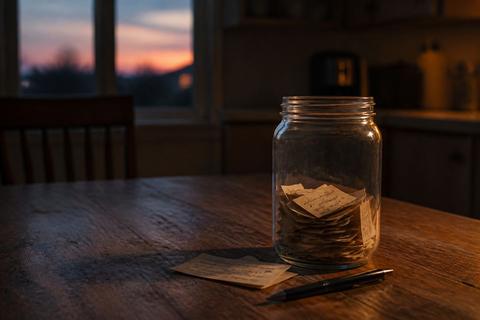
The Power of Gratitude: Transform Your Life

The power of gratitude to transform your life is not about magical thinking, it is about what happens in your brain and your relationships when you consistently notice what is already good. Gratitude is a skill, not a feeling that shows up on its own. You build it the same way you build any habit: with a specific practice, repeated on a schedule, tracked well enough that you can tell if it is working.
What gratitude actually does (and does not do)
Gratitude does not attract money, fix a relationship by itself, or manifest a job offer. What it does is change where your attention goes. Most people's attention defaults to problems, threats, and what is missing, a pattern psychologists call negativity bias: negative events register more strongly in memory and emotion than positive ones of the same size. A gratitude practice is a deliberate counterweight to that default. It does not erase problems. It changes how much room they take up in your head.
The research behind it
The most cited study on this comes from psychologist Robert Emmons at UC Davis. In his research, people who kept a weekly gratitude journal exercised more, reported fewer physical symptoms, felt better about their lives overall, and were more optimistic about the coming week, compared to people who logged hassles or neutral events instead. They also made more progress on personal goals over a two-month period.
A separate randomized controlled trial with 293 adults in university counseling found that writing gratitude letters alongside psychotherapy led to significantly better mental health scores at 4 and 12 weeks than psychotherapy alone or psychotherapy plus expressive writing. The mechanism the researchers identified: gratitude writing reduced the proportion of negative-emotion words people used, and that reduction, not the act of writing itself, predicted the improvement.
Two things worth being honest about: these are group averages, not guarantees, and the effect sizes in gratitude research are typically modest, not life-altering overnight. It is a tool that nudges outcomes, not a switch that flips them.
Why it works: three mechanisms
It interrupts rumination
Writing down something specific you are thankful for occupies the same mental channel that rumination uses. You cannot simultaneously spiral on a worry and describe, in detail, why your neighbor helping you carry groceries mattered. Five minutes of that redirection, done consistently, adds up.
It reframes comparison
Self-esteem takes a hit when you measure yourself against a curated version of someone else's life. Naming what you actually have and did, in your own words, is a direct counter to that comparison loop, because it forces specificity instead of a vague sense of lacking.
It reinforces relationships through action, not just feeling
Thinking you're grateful for someone changes nothing by itself. Telling them, in a text or a note, changes the interaction. Studies on gratitude visits and letters show that expressing thanks directly to another person produces stronger, more durable effects on relationship satisfaction than journaling privately, because it is reciprocal: the other person responds.
A gratitude practice that actually holds up over time
Most people quit gratitude journaling within two weeks because the format is vague and starts to feel repetitive. Specificity and rotation fix that.
1. Pick a cadence you'll actually keep
Daily journaling burns out fast for most beginners because entries get repetitive: the same “grateful for my family” line every day stops meaning anything after a while. Emmons' own data found that a once-a-week practice produced comparable, sometimes better, results than daily journaling, partly because people did not habituate to it. Start with three entries a week, not seven.
2. Name the specific, not the category
“Grateful for my job” is a category. “Grateful that Maria covered my shift Tuesday without me asking twice” is specific. Specific entries force you to notice a real moment instead of pattern-matching a generic answer, and specificity is what the research entries actually looked like.
3. Write why it mattered, in one sentence
After the item, add why: what it let you do, feel, or avoid. This is the step most people skip, and it is the step that turns a list into reflection.
4. Say it out loud to one person, once a week
Pick one thing from your list and tell the person directly: in person, by call, or in a written note. This is the piece journaling alone cannot replicate.
5. Track it somewhere you will actually reopen
A note-taking app, a physical notebook by the bed, whatever you will actually revisit. Rereading old entries during a hard week is part of why the practice works. A journal you never reopen is just a list.
Where this fits and where it does not
Gratitude practice is a reasonable, low-cost habit for improving mood, focus, and how you show up in relationships. It is not a treatment for clinical depression or anxiety, and it is not a substitute for therapy, medication, or addressing a genuinely harmful situation. A gratitude journal is not the answer to an abusive relationship or an unsafe job. If low mood, sleep problems, or anxiety are persistent and interfering with daily life, talk to a doctor or licensed therapist. Gratitude practice can sit alongside that care, not replace it.
Common obstacles
Running out of things to write
That is usually a sign you are still writing categories, not moments. Narrow the lens to the last 24 hours and one interaction, one small relief, one thing that worked the way it was supposed to.
It feels forced during a genuinely bad week
Skip the day, or write about something small and neutral (the coffee was hot, the bus was on time) rather than forcing a positive spin on real pain. Gratitude practice is not about denying that things are hard.
Forgetting to do it
Attach it to something you already do daily, brushing your teeth, making coffee, closing your laptop, so it rides on an existing habit instead of needing its own reminder.
FAQ
How long before I notice a difference?
In the Emmons studies, measurable differences in mood and outlook showed up within a few weeks of consistent practice, not the first day. Give it three to four weeks before judging whether it is working for you.
Does gratitude journaling replace therapy?
No. It is a self-help habit with modest, real effects on mood and outlook. It is not a clinical treatment, and it should not delay getting professional help for ongoing depression, anxiety, or trauma.
Is there a wrong way to do it?
The main failure mode is vagueness: writing the same generic entry on autopilot until it stops meaning anything. Specific, varied entries plus occasionally saying it out loud to someone outperform a private, repetitive list.