Exploring Ancient Rituals for Modern Well-Being
Exploring ancient rituals for modern well-being usually starts with a simple observation: people who light a candle before journaling, walk the same path every morning, or say a set phrase before a hard conversation often report feeling steadier than people who don't. That isn't magic. It's a mix of nervous-system regulation, attention training, and the psychological effect of structure. This article walks through six practices with ancient roots, what they actually do for your mind and body, and how to run them without the mysticism getting in the way of the mechanics.
Why Repeated, Structured Actions Calm People Down
Rituals are old because they solve an old problem: uncertainty is stressful, and a fixed sequence of actions gives the brain something predictable to hold onto. Researchers at Harvard Business School had participants perform a short, personal ritual before a stressful task (singing in public, then a timed math test) and found lower heart rate and lower self-reported anxiety compared with people who just sat quietly beforehand. The effect depended on participants believing the sequence counted as a "ritual" rather than random movements (Psychology Today, summarizing the HBS research). That's the honest version of what a ritual does: it doesn't change the exam or the audience, it changes your physiological state going into them.
What This Means for a Daily Practice
If you want the anxiety-reduction effect, consistency matters more than symbolism. A two-minute sequence you repeat before every stressful event (same order, same objects, same few sentences) conditions your body to associate that sequence with "I've done this before, I can do this again." An elaborate ritual you only do once won't have the same effect.
Six Practices, and What They're Actually Doing
1. Meditation and Breath-Focused Attention
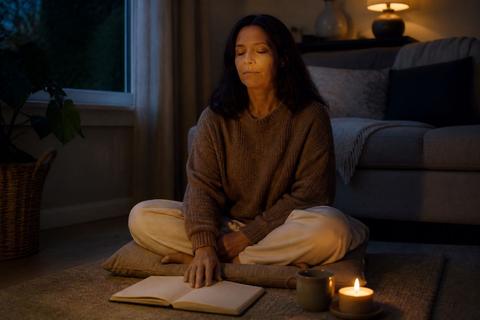
Meditation traditions across Buddhism, Hinduism, and Taoism converge on the same basic move: hold attention on one thing (breath, a phrase, a sensation) and notice when it wanders, then return. The U.S. National Center for Complementary and Integrative Health reviewed the clinical evidence and reports that mindfulness-based approaches performed as well as cognitive behavioral therapy and antidepressant medication on some anxiety and depression measures, and that meditation has been linked to modest reductions in blood pressure and cortisol in several studies (NCCIH, "Meditation and Mindfulness: Effectiveness and Safety"). NCCIH also notes it isn't risk-free for everyone: about 8% of practitioners in one review reported a negative effect, most often increased anxiety or low mood, and it should not replace treatment for a diagnosed condition.
To start: sit for 5 minutes, count each exhale up to 10, and restart at 1 when you lose count. Add time only once 5 minutes feels easy, not before.
2. Smudging and Scent-Based Space Rituals
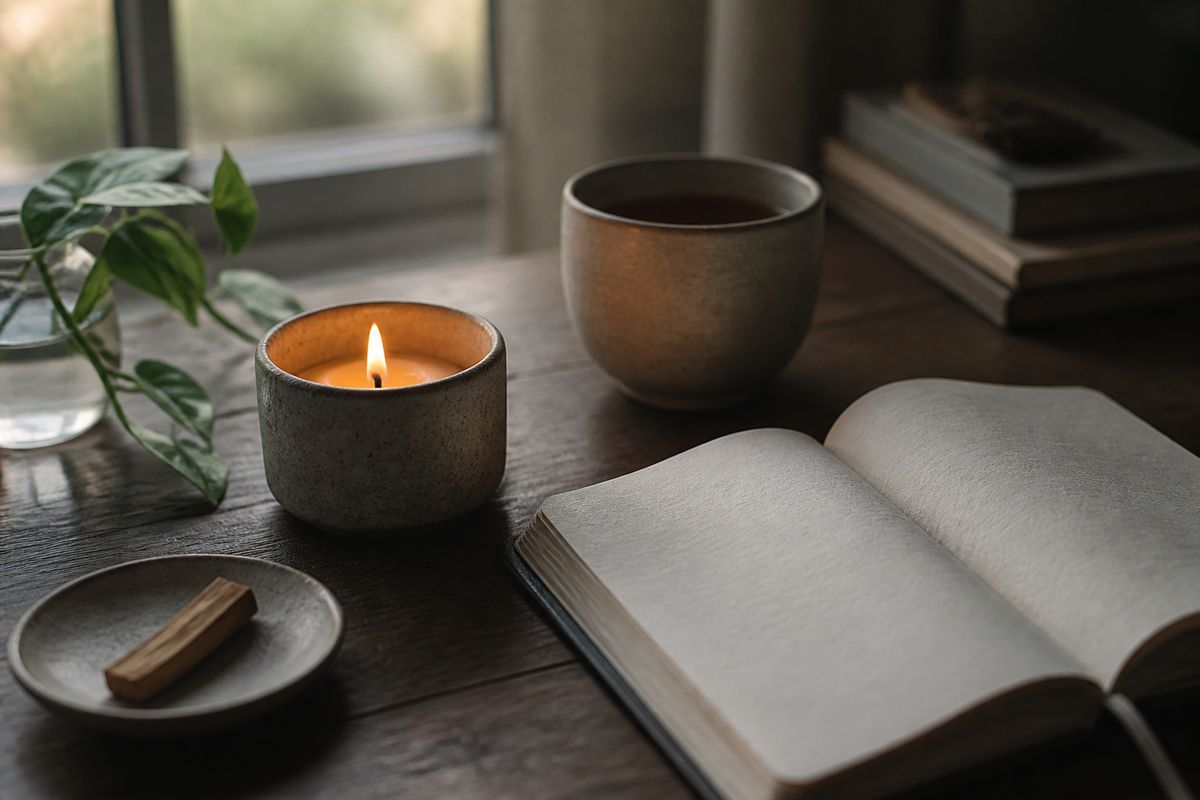
Burning dried sage, cedar, or other herbs to mark a space as "reset" is a specific Indigenous North American ceremonial practice, not a generic wellness prop. Treat it as belonging to that tradition, and if you're outside it, consider the same before/after structure with a candle or diffuser instead. What the ritual does psychologically is give you a clear transition marker: light it, name one thing you're leaving behind, let the smoke or scent clear, then start the next task. The scent becomes a cue your brain links to "this phase is over," similar to how changing out of work clothes signals the workday has ended.
If you do burn herbs: ventilate the room, never leave it unattended, and keep a heatproof dish underneath.
3. Moon-Phase Reflection
There's no controlled evidence that lunar phases affect mood, sleep, or behavior; that link doesn't hold up when tested rigorously. What the moon-cycle framework is actually useful for is pacing: a roughly 29-day cycle gives you a recurring checkpoint to write down a goal (new moon) and review progress against it (full moon), which is really goal-setting with a built-in review date. If the moon isn't your thing, the 1st and 15th of the month will give you the same planning structure.
4. Breathwork
This is the practice with the clearest short-term physiological evidence here. A Stanford Medicine study of 111 adults compared five minutes of daily "cyclic sighing" (a double inhale through the nose, then one long, slow exhale through the mouth) against mindfulness meditation and other breathing patterns over one month. The cyclic-sighing group showed a larger daily improvement in mood than the meditation group and was the only group to significantly lower its resting breathing rate over the course of the study (Stanford Medicine, "Cyclic sighing can help breathe away anxiety"). The long exhale is doing the work: it engages the parasympathetic nervous system, the branch that slows heart rate and lowers arousal.
To practice: inhale through your nose, take a second short inhale on top of it to top off your lungs, then exhale slowly through your mouth until your lungs feel empty. Repeat for 5 minutes, once or twice a day.
5. Gratitude Journaling
Of the six practices here, gratitude journaling has the most direct randomized-trial support, with an important caveat. A randomized controlled trial of 120 university students at Dalhousie University tested a gratitude-exercise app against a control app over three weeks. Students who started with at least moderate depression, anxiety, or stress symptoms showed a significant improvement afterward; students with low symptoms at baseline saw no measurable benefit (randomized controlled trial, PubMed Central). In other words, gratitude journaling looks most useful as a tool for people who are currently stressed or low, not as a guaranteed mood booster regardless of starting point.
A version worth trying: each night, write three specific things from that day ("the coworker who covered my shift," not "my job"), and once a week, tell one of those people you appreciated them, in person or by text.
6. Outdoor Walking
Walking outside combines two things that are independently well-studied: moderate aerobic movement and a change of sensory environment. Neither requires ritual framing to work, but treating a walk as a deliberate practice (same time of day, phone away, attention on what you can hear and smell rather than your task list) makes it more likely you'll actually keep doing it, which is where most of the benefit comes from. Fifteen to twenty minutes is enough to matter; you don't need an hour.
What These Practices Do and Don't Do
They do: lower physiological arousal in the moment (breathwork, meditation), create a psychological transition marker (smudging, pre-stress ritual), improve mood and reduce symptoms for people who are currently distressed (gratitude journaling), and give you a recurring structure for goal review (moon-phase or monthly reflection). They don't: cure a diagnosed anxiety or mood disorder on their own, replace therapy or medication, or work identically for everyone. Both the Dalhousie gratitude trial and the NCCIH meditation review found the benefit was strongest for people who were already struggling, and NCCIH explicitly says meditation isn't a substitute for conventional care.
Building a Routine That Actually Sticks
Pick one practice, not six. Attach it to something you already do daily (coffee, brushing your teeth, getting into bed) so you don't have to remember it separately. Give it two weeks before judging whether it's doing anything: the studies above ran three weeks to a month, not a single session. If a practice doesn't fit your schedule or beliefs, drop it. The mechanism (attention, breath, structure, written reflection) matters more than the specific tradition it came from.
Frequently Asked Questions
Do ancient rituals actually change what happens to me, or just how I feel about it?
Based on the research above, mostly the latter. Breathwork and meditation change your physiological stress response; ritual and journaling change your psychological state and follow-through. None of that alters external events on its own, but a calmer nervous system and clearer goals do tend to produce better decisions and follow-through, which is where the real-world benefit comes from.
How long before I notice anything?
The Stanford breathwork study measured effects daily over a month, with mood improvements showing up within the first week and growing over time. The gratitude journaling trial ran three weeks. Give any new practice at least two consistent weeks before deciding whether to keep it.
Is smudging appropriate for everyone to practice?
Smudging with sage is a specific Indigenous ceremonial practice, not a generic wellness trend. If you don't have a connection to that tradition, consider a candle-lighting or scent-based transition ritual instead, or research the practice's origins and protocols before adopting it.