The Benefits of Crafting Personalized Rituals

The benefits of crafting personalized rituals come down to a simple mechanism: a repeated, intentional action gives your brain a consistent cue to shift state, whether that's from wired to calm, distracted to focused, or scattered to grounded. A ritual is not magic. It's a routine you've deliberately built and attached meaning to, and that combination of repetition and meaning is what makes it work.
What Counts as a "Personalized Ritual"
Strip away the mystique and a ritual is a structured action performed the same way, on a repeating basis, that you've assigned significance to. Brewing coffee a specific way each morning can be a ritual. So can a five-minute stretch before bed, a Sunday phone call to a parent, or lighting a candle before you sit down to write. What separates a ritual from a plain habit is intention: you've chosen it on purpose, for a reason that matters to you, rather than just fallen into it.
This matters because a ritual borrowed wholesale from someone else, a wellness influencer's exact morning routine, for example, rarely sticks. The specific ingredients matter less than whether the ritual reflects what you actually value and what your schedule can actually sustain.
Where the Psychological Benefit Actually Comes From
Predictability Lowers Anxiety
Uncertainty is mentally expensive. When part of your day is fixed and predictable, your brain doesn't have to spend effort deciding what happens next, which frees up attention for everything else. A consistent evening wind-down routine is a well-studied example: sleep researchers recommend reserving the last 30 to 60 minutes before bed for calm, low-stimulation activity, dimmed lights, reading, light stretching, rather than screens or stressful conversation, because it signals to your body that sleep is coming next. The Sleep Foundation and Harvard Health both frame this as one of the most reliable, low-cost ways to improve sleep onset (Harvard Health, Sleep Hygiene).
Naming Feelings Reduces Their Grip
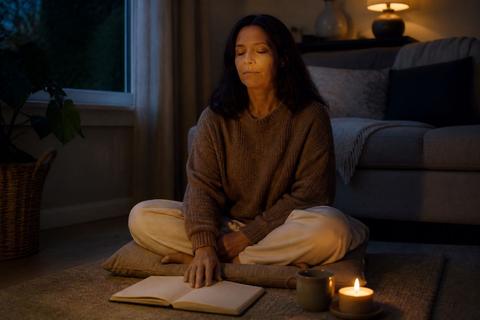
A journaling ritual, writing at the same time each day about what's actually on your mind, has real research behind it, though the specifics matter. Psychologist James Pennebaker's expressive-writing studies had participants write for 15 to 30 minutes about an emotionally difficult experience over 3 to 4 consecutive days. In the original study, students who did this visited the campus health center at about half the rate of students who wrote about neutral topics in the months that followed (APA, Speaking of Psychology). Pennebaker himself has since said this doesn't need to be a daily habit forever, a few focused sessions during a genuinely hard stretch can do the job. The ritual isn't the writing itself; it's giving yourself permission to sit with a feeling long enough to name it.
Rituals During Loss or Uncertainty
Structured actions can help during grief or major transitions, not by resolving the loss but by giving you something concrete to do when everything else feels formless. A specific remembrance action, lighting a candle on an anniversary, visiting a particular place, is not a treatment for grief and won't shorten the grieving process. What it offers is a predictable container for a feeling that otherwise has no edges.
What Rituals Can Do for Focus and Follow-Through
A Fixed Start Signal Beats Willpower
Deciding, in the moment, whether to start work is a decision point, and decision points are where procrastination lives. A short pre-work ritual, the same three or four minutes every time, reviewing your task list, clearing your desk, making the same drink, removes that decision. You're not deciding whether to start; you're just doing the thing you always do before starting. This is closer to environmental cueing than motivation, and it's why the same ritual performed in the same place tends to outperform an inconsistent one.
Rituals Around Food and Movement
A ritual doesn't have to be abstract. A weekly meal-prep block with the same three steps, plan, shop, cook, or a fixed 20-minute walk after lunch, works precisely because it removes re-negotiation. You don't ask "should I go for a walk today," you just do the thing that's already scheduled. The health benefit isn't from the ritual label; it's from the consistency the ritual enforces.
Wind-Down Routines and Sleep Quality
Beyond the general wind-down window mentioned above, the specific sequence matters less than the consistency of it. Doing the same three or four things in the same order each night, dim lights, brush teeth, read five pages, teaches your body to associate that sequence with sleep onset. This is a documented sleep-hygiene recommendation, not a placebo effect: the CDC and Sleep Foundation both list a fixed bedtime and consistent pre-sleep routine among the highest-leverage, lowest-cost sleep interventions available.
Rituals for Connection
Self-Reflection Without a Journal
Not everyone wants to write. A ritual of five minutes of quiet reflection, naming one thing that went well and one thing you'd do differently, can do similar work to journaling for people who find writing itself to be a barrier. The mechanism is the same: consistent, brief self-check-ins build a habit of noticing your own patterns instead of letting the week blur past unexamined.
Shared Rituals Build Relationship Stability
A recurring shared action, a weekly family dinner, a monthly call with a friend, a specific way you greet a partner at the end of the day, works because both people can rely on it. Relationship researchers consistently point to predictability and responsiveness, not grand gestures, as what builds trust over time. A shared ritual is a low-effort, repeatable way to guarantee that predictability actually happens instead of getting crowded out by a busy week.
Building Your Own Ritual: A Concrete Process
Skip the vague "figure out what feels right" advice. Use this sequence instead:
Name the specific problem first. Not "I want more calm" but "I check my phone the second I wake up and feel behind all day" or "I can't fall asleep before midnight." A vague intention produces a vague ritual that's easy to skip.
Pick one action, not five. One ritual with one clear trigger (after I pour coffee, after I close my laptop, after I brush my teeth) beats an elaborate five-step routine you'll abandon within a week.
Set a real time limit. Two to five minutes for a new ritual. You can extend it once it's automatic; you can't sustain something that feels like a chore from day one.
Attach it to something you already do daily. Anchoring a new ritual to an existing habit, right after brushing your teeth, right before you sit down at your desk, removes the "when do I even do this" friction that kills most new routines in the first ten days.
Track it for two weeks, plainly. A checkmark on a calendar is enough. You're checking whether the ritual survives a normal, busy week, not whether you feel transformed.
Adjust based on what actually happened, not what you hoped would happen. If you skipped it four out of fourteen days, the ritual is probably too long, too complicated, or scheduled at the wrong time. Shrink it before you give up on it.
What Personalized Rituals Do Not Do
It's worth being direct about the limits here. A ritual will not manifest a specific outcome, attract money or a relationship into your life, or substitute for medical or mental health treatment. What the research above actually supports is narrower and more useful: consistent, intentional routines can lower anxiety through predictability, support emotional processing, improve sleep onset, and make follow-through on goals easier by removing repeated decision-making. That's a real, practical benefit. It's just not the same claim as "this ritual will change your external circumstances."
FAQ
How long does it take for a ritual to feel automatic?
There's no fixed universal number of days, timelines vary a lot by person and by how demanding the ritual is. A ritual kept small enough to survive a bad week will become automatic faster than an ambitious one you can only manage when everything else is going well.
Do rituals need to be daily to work?
No. A weekly ritual, like a Sunday planning session or a monthly remembrance practice, can be just as effective as a daily one if the frequency matches what the ritual is for. What matters is that it actually recurs, not that it recurs every day.
Can a ritual replace therapy or medical care?
No. Rituals can support mood, focus, and coping, but they are not a treatment for anxiety disorders, depression, grief complications, or other clinical conditions. If a ritual is the only thing keeping you afloat, that's worth mentioning to a professional.
What if my ritual stops working after a while?
That's common, and it doesn't mean the whole idea failed. Novelty fades and life circumstances change. Revisit the six-step process above, name what's not working specifically, and adjust one variable at a time rather than abandoning the practice altogether.