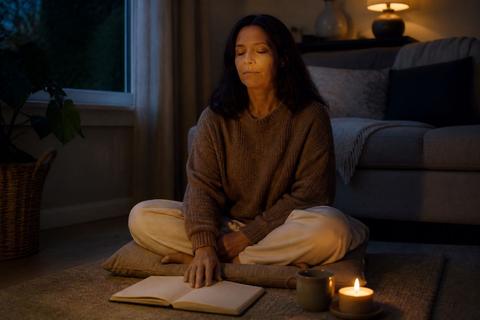
Transformative Journaling Rituals for Self-Discovery

Transformative journaling rituals for self-discovery work because they turn vague self-reflection into a repeatable practice with a specific format and a specific time slot. Journaling won't rewrite your circumstances, but it's one of the better-studied tools for organizing your thinking, processing emotion, and noticing patterns in your own behavior. This article walks through seven concrete rituals, how to run each one, and how to build a simple writing space you'll actually return to.
Why Journaling Supports Self-Discovery (and What It Doesn't Do)
Putting thoughts into words forces you to structure them. That's the mechanism, not magic. Some of what a regular practice can realistically do:
- Clarifies thoughts. Writing slows down racing or circular thinking so you can see one idea at a time instead of a tangle of them.
- Tracks change over time. A dated journal is the only honest record of what you actually believed six months ago versus now.
- Loosens creative blocks. Low-stakes, unedited writing gets you past the internal critic that blocks first drafts of ideas.
- Processes emotion. In a widely cited set of studies by psychologist James Pennebaker, college students who wrote about a personally traumatic experience for 15 minutes on four consecutive days visited the campus health center less often over the following six months than students who wrote about trivial topics (Harvard Health Publishing). That's evidence for short, structured emotional writing helping physical stress markers, not evidence that journaling attracts specific outcomes into your life.
- Surfaces patterns. Re-reading old entries is often the fastest way to spot a recurring worry, a repeated excuse, or a value you keep de-prioritizing.
What it doesn't do: guarantee a breakthrough on a schedule, replace treatment for depression, anxiety, or trauma, or work if you only do it once. Treat it as a mood and clarity tool, not a fix.
Setting Up a Space You'll Actually Use
A dedicated journaling spot matters less for its atmosphere and more for reducing friction. If your journal is buried in a drawer, you won't reach for it at 11pm.
- Pick one recurring spot. Same chair, same corner of the couch, same desk. Familiarity removes a decision you'd otherwise have to make daily.
- Keep the barrier to entry near zero. Notebook and pen sitting open on the nightstand, not in a bag in another room.
- Cut one distraction, not all of them. Phone on airplane mode for 10 minutes is realistic; trying to eliminate all noise usually isn't.
- Choose a notebook that matches the ritual. Lined pages for prompt work, blank pages if you're going to sketch or collage for vision journaling.
Seven Journaling Rituals and How to Run Them
1. Morning Pages
Popularized by Julia Cameron in The Artist's Way, Morning Pages means writing three longhand pages first thing in the morning, before checking your phone.
How to practice it
- Write immediately after waking, before coffee if you can manage it, while your inner editor is still half-asleep.
- Fill three pages by hand. Typing changes the exercise; the slower pace of handwriting is part of the point.
- Don't reread or revise mid-session. Grammar and coherence are not the goal, output is.
2. Gratitude Journaling
Gratitude journaling means writing down specific things you're thankful for on a regular schedule. Research summarized by the University of Rochester Medical Center links gratitude practice with reduced stress, improved mood, and better sleep (University of Rochester Medical Center). The effect size is modest and it isn't a treatment for clinical depression, but it's one of the cheapest, best-replicated habits in this list.
How to practice it
- Pick a consistent time, evening works well since you're reviewing a completed day.
- Write three to five specific items. Not "my family," but "my sister called just to check in on Tuesday."
- Specificity matters more than volume. Five vague items add less than two detailed ones.
3. Timed Freewriting
Freewriting means writing continuously for a set window without stopping to edit, so thoughts you'd normally filter out reach the page.
How to practice it
- Set a timer for 10 to 15 minutes. A visible countdown keeps you from stopping the moment it gets uncomfortable.
- Keep the pen moving even if you're writing "I don't know what to write" on repeat. That sentence usually breaks after a minute or two.
- Skip punctuation and paragraph breaks if they slow you down. This draft is not for anyone else to read.
4. Prompt-Based Journaling
A single, well-chosen question can do more than an open blank page, especially on days when freewriting feels aimless.
Prompts worth trying
- "What does success mean to me, specifically, this year?"
- "Describe a time I overcame a hard situation and what actually got me through it."
- "What are three values I keep saying matter to me but haven't acted on this month?"
How to practice it
- Choose one prompt per session rather than answering several at once. Depth beats coverage here.
- Give yourself a minute of silence before writing to let an honest answer form, instead of the first socially acceptable one.
5. Vision Journaling
Vision journaling means pairing images and short written notes around a specific goal, on paper, in your own journal rather than a broad vision board.
Be precise about what this does: writing a goal down and revisiting it regularly keeps that goal in front of you and supports follow-through planning. A well-known study by Dr. Gail Matthews at Dominican University of California found that participants who wrote down their goals, wrote action steps, and sent weekly progress updates to a friend reported meaningfully higher goal achievement (roughly 70%+) than those who only thought about their goals without writing them down or reporting on them (around 35%), as summarized by Michigan State University Extension. That's a case for writing goals down plus building in accountability and action steps, not evidence that visualizing an outcome pulls it toward you.
How to practice it
- Pick one goal per page instead of a collage of everything you want. Focus is what makes this useful.
- Under the image, write two or three concrete next actions, not just the outcome.
- Revisit the page weekly and update what you actually did, not just how you feel about the goal.
6. Reflective End-of-Day Journaling
A short nightly review turns a blur of a day into something you can actually learn from.
How to practice it
- Set aside five minutes before bed, ideally at the same time each night.
- Answer three fixed questions: What happened today that mattered? How did I feel through most of it? What would I do differently tomorrow?
- Keep answers to a few sentences each. This ritual works better as a quick log than a long essay.
7. Letter Writing
Writing a letter you may never send is a way to say the full, unfiltered version of something you can't say out loud yet.
How to practice it
- Pick one person, including yourself, as the letter's audience.
- Write everything you'd actually want to say, without softening it for their comfort.
- Decide afterward whether it gets sent, burned, filed, or reread in six months. The decision doesn't have to happen before you write it.
Adding Mindfulness Without Overcomplicating It
A few small additions change how present you are during any of the rituals above:
Breathe first
Ninety seconds of slow inhale-through-the-nose, exhale-through-the-mouth breathing before you start settles a racing mind faster than diving straight into the page.
Name an intention
Before writing, decide in one sentence what you're trying to get out of this specific session. Naming it, for example "I want clarity on why I'm avoiding this conversation," focuses the session more than opening the notebook with no target.
Check in with your body
Pause mid-entry and notice where you're holding tension. A tight jaw or clenched stomach while writing about a topic is often a truer signal than the words on the page.
When You Hit Writer's Block
- Change location. A different room, a porch, a coffee shop can be enough to unstick a stalled session.
- Read something first. A page of someone else's writing can prime your own, especially on freewriting days.
- Use a prompt as a fallback. Blank-page pressure is the most common cause of block; a single question removes it.
Building the Habit
Pick one ritual, not all seven, and run it for two weeks before adding another. Anchor it to something you already do daily, like after coffee or after brushing your teeth, so it doesn't depend on willpower alone. The specific ritual matters less than whether you actually keep opening the notebook.
FAQ
How long should each journaling session be?
Ten to twenty minutes is enough for most of these rituals. Morning Pages and letter writing tend to run longer; gratitude and end-of-day reflection can be done in five.
Do I need a special journal or app?
No. A plain notebook works for every ritual here. Handwriting is worth trying for Morning Pages and letter writing specifically, since the slower pace changes what comes out; apps are fine for quick gratitude lists or prompt answers.
Can journaling replace therapy?
No. It can support mood, processing, and self-awareness, but it isn't a substitute for treatment if you're dealing with clinical depression, anxiety, trauma, or another mental health condition. Talk to a licensed professional for those.
What if I skip a few days?
Restart without a penalty entry or an apology paragraph. Consistency over months matters more than an unbroken streak.