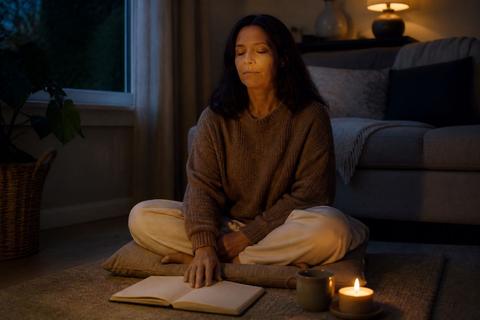
How to Develop a Gratitude Ritual for Daily Joy

How to develop a gratitude ritual for daily joy comes down to picking a fixed time, writing a short and specific list, and doing it often enough to build the habit but not so often that it goes stale. Gratitude practice won't rearrange your circumstances or manifest new ones. What it does, according to a growing body of psychology research, is shift attention toward what's already working, which measurably affects mood, sleep, and how you handle stress.
What a gratitude ritual actually does
Gratitude is the practice of noticing and naming specific good things in your life, then pausing on them long enough for the feeling to register instead of gliding past it. It's a mindset and attention tool, not a request sent out into the universe. The mechanism is ordinary: you're deliberately practicing a shift in what you pay attention to, the same way exercise is a deliberate practice for your body.
The research backing is real, but it's about well-being and behavior, not external outcomes. A large observational study of nearly 49,000 older women in the Nurses' Health Study, published in JAMA Psychiatry, found that women who scored in the top third on a gratitude questionnaire had a 9% lower risk of dying over the following four years than those in the bottom third, with gratitude also linked to better sleep quality and favorable cardiovascular markers. That's an association in one population of older adults, not proof that journaling adds years to your life, and the researchers were upfront that it doesn't establish cause and effect. What it does support is the more modest claim: people who already notice and register the good things in their lives tend to also be sleeping better and managing stress better.
Building the ritual, step by step
Step 1: Pick one fixed time, not "whenever"
Decide on a specific day and time before you start, the same way you'd schedule a recurring appointment. Morning sets a tone for the day; right before bed gives you something other than the day's leftover stress to fall asleep on. Either works. What doesn't work is "I'll do it when I feel like it", that's how the ritual quietly disappears after week two.
Step 2: Decide how often, and don't default to daily
This is the part most advice gets wrong. Research by psychologist Sonja Lyubomirsky found that people who wrote in a gratitude journal once a week for six weeks reported a bigger boost in happiness than people who wrote three times a week. The likely explanation, per the Greater Good Science Center at UC Berkeley, is hedonic adaptation: repeat any positive exercise too often and it turns into a checklist item, and the emotional payoff fades. If you want a daily habit, keep it brief (one line); if you want the entry to actually land, once or twice a week with more detail beats a rushed daily list.
Step 3: Write 3-5 things, and go deep on at least one
List three to five things you're grateful for, mixing genuine range: a specific interaction, something about your body or health, a small sensory pleasure, something you almost missed. Then pick just one of them and write two or three sentences on why it mattered, not just that it happened. The same Berkeley research summary notes that elaborating on one specific thing in detail produces more benefit than a superficial list of many things, the depth is doing the work, not the count.
Step 4: Name specifics, not categories
"Grateful for my family" is a category and it won't move the needle much because you've read that sentence in your head a hundred times before. "Grateful my sister called just to check in on a Tuesday for no reason" is a specific, retrievable memory. Specificity is what separates a ritual that produces a real emotional response from one that produces the same three vague lines every time.
Step 5: Add one mindfulness minute
Before or after writing, sit for 60 seconds and actually feel whatever came up rather than immediately moving to the next task. This is the difference between logging gratitude and experiencing it. If you skip this step, the ritual becomes paperwork.
Step 6: Say it out loud sometimes, not just on paper
Telling someone directly, or writing them a short note, adds a social component that a private journal doesn't have. Research on gratitude letters has found the letter alone helps the writer's mood, but delivering it and having the other person read it in front of you produces a noticeably bigger and longer-lasting effect than writing it and keeping it in a drawer. You don't need to do this often, once a month is plenty, but it's worth doing at least occasionally rather than treating gratitude as a purely solo, silent practice.
Step 7: Expect flat days, and have a fallback for them
Some days you'll stare at the page and nothing comes. That's normal, not a sign the practice has stopped working. On those days, lower the bar: name one small sensory thing (a warm shower, a good cup of coffee) instead of forcing a profound entry. Re-reading two or three old entries also works, it reminds you the well isn't actually dry, you're just tired.
Step 8: Review monthly, don't just accumulate pages
Once a month, skim back through what you wrote. Look for patterns: the same three people showing up, the same kind of moment (quiet mornings, finishing a task, being outside). This is where a gratitude ritual actually informs decisions, if you notice you're consistently grateful for unstructured time and never for busy social events, that's useful information about what to protect on your calendar.
What this practice does not do
A gratitude ritual will not attract money, a relationship, or a specific outcome into your life, and it's not a substitute for treatment if you're dealing with clinical depression or anxiety, talk to a professional for that. What the research does support is narrower and still worthwhile: it's associated with better mood regulation, better sleep quality, and in at least one large study, better long-term health markers in the population studied. Treat it as a habit that changes your attention and your baseline mood, not a mechanism for changing external events.
FAQ
How long before I notice a difference?
Small mood effects are often reported within a few weeks of consistent practice; the Lyubomirsky research measured outcomes at six weeks. Give it at least a month on a once- or twice-weekly cadence before deciding it isn't working.
Should I use an app or a paper notebook?
Either is fine. Paper removes notification friction and forces a slower pace, which tends to help with the "go deep on one thing" step. An app is better if you know a paper notebook will get lost or skipped.
What if I keep writing the same three things?
That's a sign to slow down and use Step 4: instead of "my job," write the specific moment from this week that made the job worth it. If you genuinely can't find anything new, that's useful data too, not a failure of the exercise.
Is gratitude journaling a replacement for therapy?
No. It's a low-cost, evidence-informed self-help habit for mood and outlook, not a treatment for clinical mental health conditions. If low mood is persistent or interfering with daily life, see a licensed provider.