How to Incorporate Rituals into Your Spiritual Practice
How to incorporate rituals into your spiritual practice comes down to picking a repeatable set of actions, tying them to a fixed time or cue, and doing them consistently enough that they become automatic rather than another item on your to-do list. A ritual won't summon outcomes or bend circumstances in your favor. What a well-built ritual does is give your mind a reliable cue for focus, mark transitions, and lower the anxiety that comes with uncertainty, and there's real psychology research behind that last part.
What a ritual actually is (and isn't)
A ritual is a fixed sequence of actions performed the same way, in the same order, mainly for what it means to you rather than for any practical outcome. Lighting a candle before meditating, saying the same three words before journaling, or always walking the same path before you write are all rituals in this sense. The actions themselves are usually simple; the structure and repetition are what make them work.
Here is the honest version of why that matters. Researchers at Harvard, UC Berkeley, the University of Chicago, Columbia, and Wharton ran a series of experiments on pre-performance rituals, scripted actions before a stressful task like public singing or a timed math test, and found that people who performed a ritual beforehand reported lower anxiety and performed better than people who sat quietly instead. A key detail: the effect only showed up when participants believed the actions constituted a "ritual", the identical physical motions, described as random behavior instead, didn't produce the same benefit. A related peer-reviewed study using EEG found that performing an arbitrary ritual before a demanding task measurably reduced the brain's stress response to making an error, even though it didn't change how many errors people actually made. Put plainly: ritual can calm you down and make failure feel less threatening. It does not appear to change objective outcomes on its own.
So treat a spiritual ritual as a psychological tool for focus, grounding, and marking transitions, not a mechanism for attracting money, love, or specific events into your life. That framing isn't a downgrade. Lower anxiety and a stronger sense of control before something that matters to you is a real, useful effect.
Step 1: Get specific about why you want this ritual
Before choosing any actions, write down one sentence describing what you want the ritual to do for you. Not "deepen my spirituality", too vague to act on. Try one of these instead: "give me 10 minutes of calm before the day gets loud," "mark the end of the workday so I stop thinking about email," or "help me sit with grief on the anniversary of a loss." A concrete purpose tells you what the ritual needs to include and how long it should take. A vague one gets abandoned by week two because you can't tell if it's working.
Step 2: Choose a fixed space and a fixed cue
Pick one physical spot you'll use every time, a corner of a room, a specific chair, a spot outside. It doesn't need to be large or elaborate; it needs to be consistent. Consistency is doing real work here: the same environment becomes a cue that tells your brain "this is ritual time," which is a large part of why the anxiety-reduction effect in the research above shows up at all. Pair the space with a fixed trigger, right after you pour coffee, right before you close your laptop, right when the sun sets, so you don't have to rely on willpower or memory to start.
Step 3: Keep the sequence short and exactly repeatable
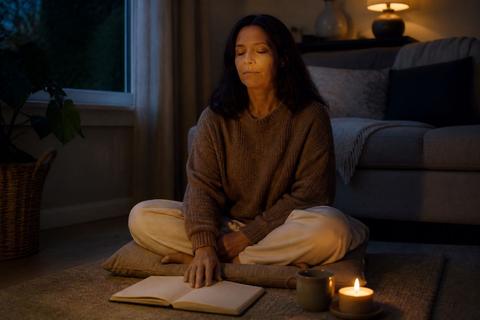
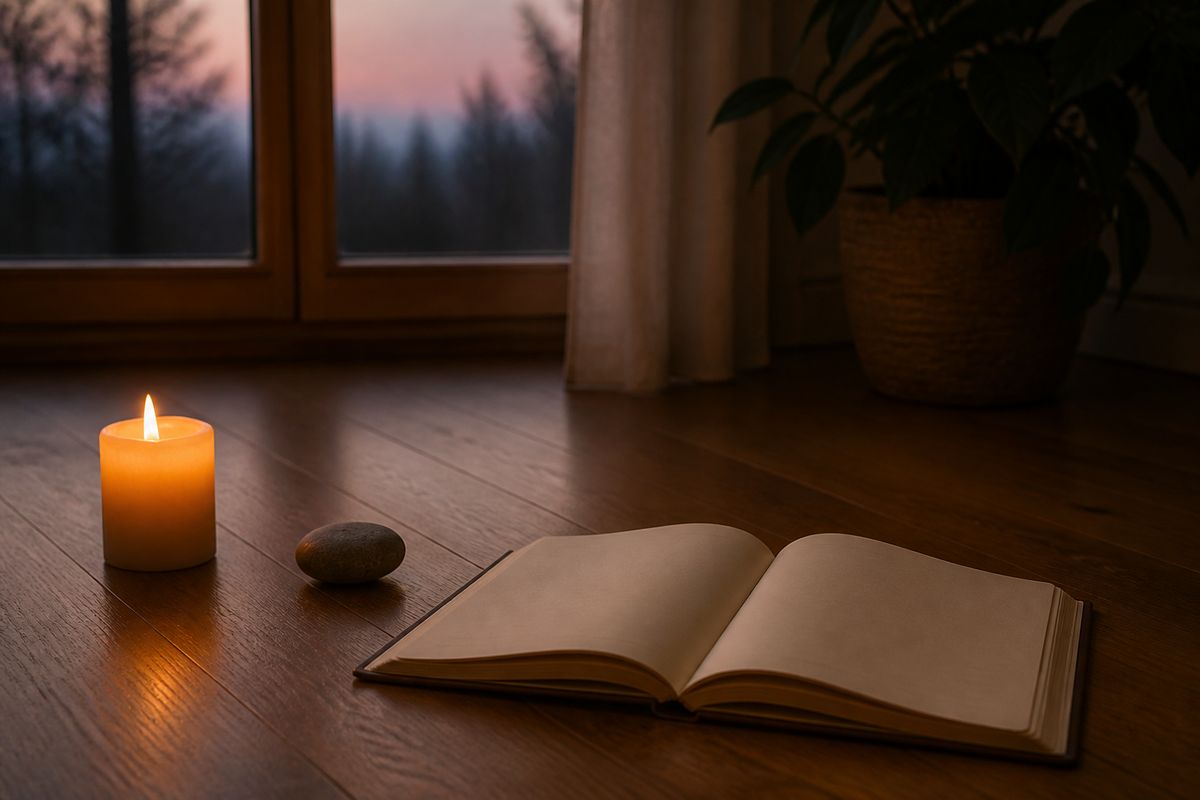
Three to five steps is plenty: light a candle, take three slow breaths, read one line from a book you return to, sit in silence for two minutes, blow out the candle. Write the sequence down the first few times so you're not improvising. The power isn't in complexity, it's in doing the same specific actions in the same order often enough that they stop requiring conscious effort. An elaborate 45-minute ritual you can only manage twice a month will teach you less about consistency than a five-minute one you actually do most days.
Step 4: Add one object or symbol that carries personal meaning
A stone from a trip, a photo, a specific scent, a piece of jewelry, something that means something to you specifically, not something you bought because a website said it was "spiritually powerful." The object's job is to be a physical anchor that snaps your attention into the ritual faster than words alone. Skip this step if nothing comes to mind; it's a booster, not a requirement.
Step 5: Set a realistic frequency, and expect it to take weeks to feel automatic
Decide up front whether this is a daily, weekly, or occasion-based ritual (new moon, the first of the month, a birthday). Daily rituals should be short, five minutes, not fifty, because the goal is a habit, not an event. Research out of University College London that tracked participants forming a new daily habit found it took an average of 66 days for a new behavior to become automatic, with a wide range (18 to 254 days) depending on the person and how complex the behavior was. Missing a single day didn't derail people in that study, but frequent, inconsistent gaps did. Translation for a ritual: don't panic over one skipped morning, but don't expect a habit to feel automatic after a week, either. Give it two months of reasonably consistent practice before you judge whether it's working.
Common rituals people build into a spiritual practice
Morning grounding
A few minutes of breathing, a short intention for the day, or reading one page of a text you find grounding. The goal is to do it before you check a phone, not after.
Gratitude practice
Writing down a small number of specific things you're grateful for is one of the more studied practices here. The Greater Good Science Center at UC Berkeley recommends sessions of about 15 minutes, at least three times a week, for a minimum of two weeks, based on research (Emmons and McCullough) showing people who kept gratitude journals reported more positive mood, more optimism, and better sleep than people who journaled about neutral daily events. That's a mood and sleep effect, not evidence that gratitude changes what happens to you externally, but better mood and sleep are real, worthwhile outcomes on their own.
Seasonal or lunar rituals
Marking solstices, equinoxes, or moon phases with a short reflection or small ceremony gives you a built-in review point roughly every one to six weeks, which is a reasonable cadence for checking whether your intentions or habits still fit your life.
Transition rituals
A short, deliberate act to mark a new job, a move, the end of a relationship, or a loss can help create psychological closure, a clear before/after line your mind can use to stop replaying the transition. This works the same way a funeral or graduation does: not magic, just a marked boundary.
Documenting what you do
Keep a short log: date, what you did, how long it took, one line on how you felt afterward. This isn't busywork. It gives you two things after a month or two: evidence of whether you're actually being consistent (memory alone overestimates this), and a record you can scan for patterns, like noticing you feel calmer after outdoor rituals than indoor ones. If a ritual isn't showing any effect after several weeks of honest logging, that's useful information, change it rather than forcing yourself to keep something that isn't doing anything for you.
Bringing others in, if you want to
Group rituals, a prayer circle, a shared meditation sit, a monthly gathering timed to a full moon, add a social dimension a solo practice doesn't have. If you're new to this, joining an existing group first is lower-effort than hosting one. If you do want to host, start small: one or two people and a simple, short structure, rather than an ambitious ceremony you'll only manage once.
What tends to get in the way
No time
Start at five minutes, not fifty. A ritual you actually complete most days beats an ambitious one you do twice a month.
Feeling like you're "doing it wrong"
There's no external authority grading your ritual. If the sequence is consistent and it does what you built it to do, calm you, mark a transition, create focus, it's working, regardless of whether it matches a tradition exactly.
Losing the feeling of meaning over time
This is normal and doesn't mean the ritual failed. Revisit Step 1: check whether the original purpose still matches what you need right now, and adjust the actions if it doesn't. A ritual built for a stressful year might need to change once that year is over.
What this practice does not do
A spiritual ritual will not attract money, a relationship, or a specific external event, and it isn't a substitute for professional support if you're dealing with clinical anxiety, depression, or grief that isn't easing over time, talk to a licensed provider for that. What the research actually supports is narrower and still genuinely useful: rituals can lower anxiety before something stressful, sharpen focus, and mark transitions in a way that helps your mind process them. Build yours around those effects, not around a promise it can't keep.
FAQ
Do I need to follow a specific tradition to build a ritual?
No. You can borrow elements from a tradition you connect with, or build something entirely your own. The research on ritual and anxiety reduction didn't depend on the ritual being religious, it depended on the person believing the actions counted as a ritual and repeating them consistently.
How long until a ritual feels automatic instead of effortful?
Plan for roughly two months of consistent practice, based on the UCL habit-formation research above, with real variation person to person. Don't judge a new ritual at two weeks.
Is it bad if I miss a day?
No. The same UCL research found a single missed day didn't meaningfully disrupt habit formation. Frequent, scattered gaps are what prevent a ritual from becoming automatic, not the occasional missed morning.
Can a ritual replace therapy or medical care?
No. It's a low-cost, evidence-informed practice for focus, calm, and marking transitions, not a treatment for clinical mental health conditions. If anxiety, depression, or grief is persistent or interfering with daily life, see a licensed provider.
Sources
- Harvard Business School Faculty & Research, summarizing the study "Don't Stop Believing: Rituals Improve Performance by Decreasing Anxiety"
- Peer-reviewed study, PubMed Central (PMC5452956)
- University College London (UCL News), reporting research by Phillippa Lally et al.
- Greater Good Science Center, UC Berkeley (Greater Good in Action), summarizing Emmons and McCullough's research