Seasonal Rituals to Embrace Nature’s Cycles

Seasonal rituals to embrace nature's cycles work less like magic and more like a scheduling trick: you attach a habit (reflection, gratitude, decluttering, rest) to a date that's already marked on the calendar, so you don't have to rely on willpower alone to remember it. Four times a year, as the season turns, you get a built-in prompt to check in with your goals, your mood, and your surroundings. None of this changes the weather or "attracts" anything to you from a distance, what it does is give your reflection and habit-building a rhythm, and that rhythm is genuinely useful. Below are concrete rituals for each season, what they're good for, and where the evidence actually stops.
Spring: clearing space and setting a direction
Spring works well as a reset point because it follows a long stretch (winter) where routines tend to slide. Use it to clear physical clutter and re-commit to two or three goals, not a fresh list of twenty.
1. A one-weekend declutter, not an open-ended project
Pick one weekend and one category, closet, kitchen drawers, one shelf of the garage. Set a 90-minute timer per session; open-ended decluttering rarely finishes and often turns into rearranging instead of removing.
- Sort into three piles: keep, donate, discard. Anything you haven't touched in 12 months goes in the donate pile unless it's seasonal gear (holiday decorations, winter coats).
- Journal for 10 minutes after: write down what you noticed while sorting, what you kept "just in case," what surprised you. This is where the mental-clearing part of the ritual actually happens, not in the sorting itself.
2. Plant something you'll actually tend
A living thing that needs regular, small check-ins is a good excuse to build a daily habit loop.
- Outdoor: choose plants native to your region, they need less water and support local pollinators. Your county extension office website usually has a free native-plant list for your zip code.
- Indoor: start with one or two low-maintenance herbs (mint, basil) in small pots on a windowsill that gets at least four hours of light. Watering them twice a week is a small, repeatable cue you can stack onto an existing habit like making coffee.
3. Ten minutes outside, most days
A large UK cohort study (nearly 20,000 people) found that people who spent at least 120 minutes a week in nature, in any combination, not necessarily all at once, were significantly more likely to report good health and high well-being than people with no nature contact, with benefits leveling off around 200–300 minutes a week (White et al., 2019). That's roughly 17 minutes a day. A short walk around the block counts.
- Mindful walks: leave your phone in your pocket and name three things you notice, one sound, one smell, one visual change since last week.
- A running list, not a full journal: keep a single note on your phone titled "Spring" and add one line each time you're outside. It turns into a useful record without the pressure of a daily entry.
Summer: momentum and follow-through
Summer's longer daylight hours make it easier to be active later in the day, which is the main reason it's a good season for building on goals you set in spring rather than starting new ones.
1. A solstice check-in (skip the metaphysics, keep the structure)
The summer solstice is just the longest day of the year, there's no evidence it changes your odds of anything. What it's good for is a fixed, memorable date to sit down and check progress on what you started in spring.
- Write down three things: one goal that's on track, one that's stalled, one thing you're grateful for from the past three months. Keep it under 15 minutes so it doesn't turn into rumination.
- If you gather with others, have each person say one specific thing (not "I'm grateful for my family" but "I'm grateful my sister called last week when I needed it"), specificity is what makes gratitude exercises land, according to the research below.
2. Get outside on purpose, not by accident
- Block one hike or outdoor outing per week on your calendar the way you'd block a meeting. Ad hoc plans get cancelled first.
- Water time counts too: sitting by a lake or river for 20–30 minutes still contributes toward that weekly nature total.
3. Cook with what's actually in season
- Visit a farmers' market every other week and buy one thing you don't normally cook with. It's a low-stakes way to break a food rut.
- Rotate two or three simple recipes around peak-season produce (tomatoes, zucchini, stone fruit, berries) instead of hunting for a new recipe every time, repetition is what makes a habit stick.
Autumn: reviewing the year and slowing down
Autumn is a natural review point: the daylight is shrinking, which nudges most people toward more indoor, reflective time anyway. Use that instead of fighting it.
1. A real harvest review
- At a family meal, go around and name one specific win from the past year, not a general "I'm thankful for my job" but "I'm thankful I got through that rough patch at work in March." Specific, personal gratitude entries are what the research on gratitude journaling actually tested, not vague statements of thanks.
- A short foraging walk (only with a local guide or verified field guide, never eat wild mushrooms you can't positively identify) is a good excuse for slow, attentive outdoor time.
2. A small, physical reflection space
You don't need anything spiritual for this to work, a dedicated physical spot just makes it easier to actually sit down and reflect, the same reason a desk helps you focus better than a couch.
- Set up a small shelf or corner with a few natural objects, leaves, acorns, a candle. The point is a visual cue that says "this is where I check in with myself," not that the objects hold any power.
- Spend 10 minutes there weekly writing down one lesson from the past season and one thing you want to carry into winter.
3. Lean into shorter days instead of resisting them
- Move one social gathering indoors around a fire pit or fireplace once the evenings cool down, the change in setting alone makes it feel like a seasonal marker.
- Cook one hearty, longer-prep meal a week (a soup, a roast, a pie) instead of a quick dinner. The extra prep time doubles as unstructured, low-stakes downtime.
Winter: rest, low light, and intention-setting
Winter's shorter days and colder weather mean less outdoor time by default, so the ritual here is mostly about protecting rest and picking a small number of intentions rather than resolutions you abandon by February.
1. A solstice intention-setting session
- Write down 1–3 intentions, each specific and behavioral ("write for 15 minutes, 4 mornings a week" rather than "be more creative"). Goal-setting research consistently finds that specific, moderately difficult goals produce better follow-through than vague ones.
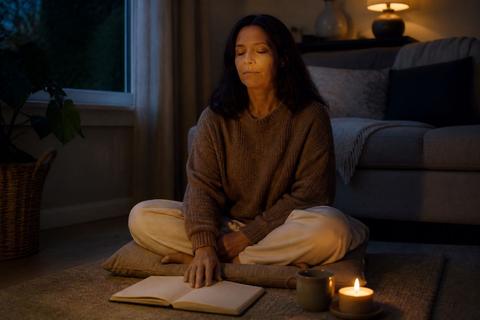
- Light a candle while you do it if you like the ritual of it, there's nothing wrong with a bit of ceremony to mark the moment, just don't mistake the candle for the mechanism. The follow-through comes from writing the goal down and reviewing it, not from the flame.
2. Bring the routine indoors, don't drop it
- Move gardening indoors: a windowsill herb pot or a small grow light keeps the habit loop from spring alive through winter.
- Keep a short winter walk on the schedule, even 10–15 minutes. Cold-weather outdoor time still counts toward the weekly nature total above, and daylight exposure in winter is also linked to steadier mood for many people.
3. Journaling and quiet time, not "clearing your mind"
Trying to think about nothing rarely works and can make anxious thoughts louder. A more reliable approach, backed by decades of research on expressive writing starting with psychologist James Pennebaker, is to write about what's actually on your mind for 15–20 minutes. Participants who wrote about stressful or difficult experiences for a few consecutive days showed better long-term emotional processing and fewer subsequent health-center visits than those who wrote about neutral topics (American Psychological Association).
- Pick one unresolved thing from the year and write about it for four days in a row, 15 minutes each time. You don't need to reread it or share it.
- Layer in ambient nature sound if it helps you settle in, but treat it as a comfort cue, not a requirement.
What this can and can't do
What it does: seasonal rituals give reflection and habit-building a predictable rhythm, which makes them easier to sustain than habits with no fixed check-in point. Gratitude practice specifically has been linked in controlled studies to reduced stress, improved mood, and better sleep, and a 2021 research review found gratitude journaling associated with better heart-health markers like blood pressure (University of Rochester Medical Center). Regular time in nature and expressive writing both have real, replicated research behind them for mood and stress.
What it does not do: none of these rituals change external events, guarantee a specific outcome, or work through symbolism alone. Lighting a candle or setting up an altar doesn't make an intention more likely to happen, writing the intention down in specific, actionable terms and reviewing it regularly does. Treat the seasonal marker as the reminder system, and the actual work (the writing, the walking, the specific goal) as the part that helps.
FAQ
Do I need to do all of these rituals to get any benefit?
No. Pick one or two per season that fit your schedule. Consistency with a small number of practices beats doing everything once and abandoning it by the next season.
How much time in nature do I actually need each week?
Research points to roughly 120 minutes a week, in any combination, as the point where self-reported health and well-being benefits become measurable, with no extra gain past about 200–300 minutes (White et al., 2019). That's about 17 minutes a day, or a couple of longer walks on the weekend.
Does gratitude journaling really do anything, or is it just a feel-good habit?
It has measurable effects, but they're modest and build over time rather than instantly. The most consistent findings are for mood, stress, and sleep, not for changing external circumstances.
Is there a "best" season to start if I've never done this before?
Start with whichever season is coming up next. The point is the recurring check-in, not a perfect starting point.
Sources
- White, M.P. et al., "Spending at least 120 minutes a week in nature is associated with good health and wellbeing," Scientific Reports (2019), via PubMed Central
- University of Rochester Medical Center, "Can Gratitude Benefit Your Health?"
- American Psychological Association, "Expressive writing can help your mental health" (Speaking of Psychology podcast/article)