
The Impact of Technology on Modern Family Life
The impact of technology on modern family life shows up less as one big shift and more as a dozen small daily trade-offs: a video call that closes distance, a phone that pulls attention away from the dinner table, a streaming queue that replaces the shared living-room screen. None of this is metaphysical or automatic; it depends entirely on the choices a household makes about when devices are on and when they are put away.
Communication: closer and more distracted at the same time
Video calls and messaging apps let families stay in contact across time zones in ways a landline never could. A parent working out of state can watch a school play live instead of hearing about it later. Group chats let extended family coordinate holidays without a chain of individual phone calls.
Where connectivity helps
The clearest win is presence at a distance: births, recitals, and daily check-ins that would otherwise be missed. For families split across households after a divorce or relocation, a nightly video call can do more for a child's sense of stability than a weekly visit.
Where it works against the family
The same devices that close geographic distance can open emotional distance inside the same room. Two people on their phones at a table are not communicating with each other even though they are physically together. The American Psychological Association's 2023 health advisory on adolescent social media use makes the point that outcomes are not fixed: the advisory states that effects "likely depend on what teens can do and see online, teens' preexisting strengths or vulnerabilities, and the contexts in which they grow up," which is a useful frame for the whole household, not just teenagers. A concrete fix that works better than a blanket ban: a phone basket at the table during meals, applied to adults too, not just kids.
Parenting decisions technology has changed
Search engines and parenting forums put more information in front of parents than any previous generation had, which is a genuine help and a genuine source of overwhelm.
Information access, used well
Looking up a pediatric symptom, comparing sleep-training methods, or finding a local support group takes minutes instead of a library trip. The risk is treating a forum thread with the same weight as a pediatrician's advice; information volume is not the same as information quality, so it's worth checking who wrote a given piece of parenting advice and whether they cite a source.
Screen time: what the guidance actually says
The American Academy of Pediatrics has moved away from a single hard time limit and toward age-based guidance plus context. Their current recommendations call for no screen use before 18 months (aside from video chatting), about one hour of high-quality content a day for children ages 2 to 5, and for school-age kids and teens a focus on making sure school work, sleep, physical activity, and in-person time aren't being crowded out, rather than a strict clock limit. See the CHOC summary of the updated AAP screen time recommendations. The AAP also recommends co-viewing with younger children and building a family media plan so the rules are explicit instead of negotiated in the moment.
Cyber safety: what actually reduces risk
Filters and app-level parental controls reduce accidental exposure to inappropriate content, but they do not replace conversation. Kids who know they can tell a parent about something upsetting online without immediately losing device access are more likely to actually report it. A workable rule: set the boundary before the device is handed over (which apps, which hours, who they can message), not after a problem shows up.
Entertainment: from shared screen to personal queue
Streaming replaced the fixed weekly broadcast slot with an on-demand library, which is convenient but removes a built-in reason for the household to be in the same room at the same time.
Streaming services
The trade-off is real: individual viewing means everyone watches what they actually want, but it also means the "whole family in one room" moment has to be scheduled on purpose now instead of happening by default. A recurring weekly pick-a-show night, rotated so each family member chooses in turn, recreates the old default without forcing anyone to watch things they dislike every time.
Video games as a bonding activity, not just a babysitter
Cooperative games that require players to work toward the same goal, as opposed to competitive or solo titles, give families a shared task and a shared conversation topic afterward. The difference between gaming as connection and gaming as a source of household tension usually comes down to whether it's a chosen shared activity or a default one kid retreats into alone for hours.
Education: access and gaps, not a universal upgrade
Remote and hybrid learning during the pandemic made two things obvious at once: digital tools can extend a motivated student's learning well past the classroom, and households without reliable internet or a personal device were left further behind, not brought up to par.
What digital tools add
Self-paced platforms let a curious kid go deeper on a subject the classroom moved past quickly, and let a struggling kid revisit a concept without holding up a whole class. That only works when an adult is checking in on what's actually being learned, not just whether a device is open.
What digital tools don't fix
A laptop does not equalize outcomes between a household with stable broadband and one without it. If remote learning is part of a child's routine, treat the internet connection and device access as a household budget line, not an afterthought.
Mental health: read the research, skip the panic
Social media's effect on family members, especially teenagers, is one of the most studied and least settled questions in this space, and the honest answer is that the evidence doesn't point to a single verdict.
What the research actually shows
The APA's advisory does not conclude that social media is uniformly harmful; it frames the risk as conditional on content, individual vulnerability, and context, and lists concrete areas to watch: sleep displacement, appearance-based comparison, exposure to content promoting self-harm or disordered eating, and signs of compulsive, addiction-like use (see the APA Health Advisory on Social Media Use in Adolescence). That's a case for monitoring specific patterns, not a case for treating all screen use as equally risky.
What a digital-detox routine looks like in practice
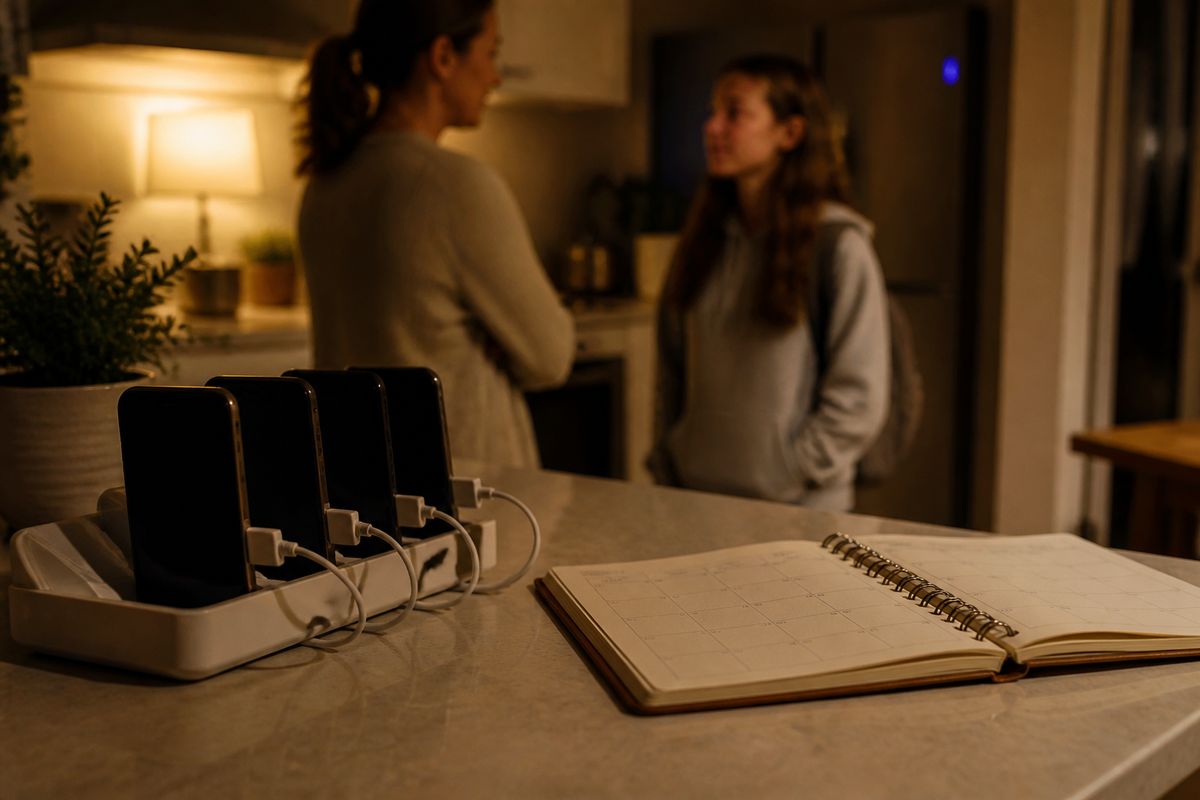
Vague "less screen time" goals rarely stick. Specific, scheduled breaks do better: a charging station outside bedrooms so phones aren't the last thing seen at night, one screen-free meal a day, or a standing Saturday-morning outdoor activity. The point isn't to reject technology; it's to make sure it's not quietly replacing sleep, exercise, and face-to-face time by default.
Building a family media plan that actually works
- Write down the specifics. "Less phone time" is not a rule; "phones charge in the kitchen after 9 p.m." is.
- Apply the rules to adults too. Kids notice when the phone-at-the-table rule only applies to them.
- Pick one recurring device-free block (a meal, a weekly outing, a Sunday morning) and protect it the same way you'd protect a standing appointment.
- Co-view when kids are young and talk about what you watched together; it turns passive viewing into a shared reference point.
- Revisit the plan every few months as kids get older and their independence and devices change.
FAQ
Is all screen time equally bad for kids?
No. Current pediatric guidance distinguishes between passive, low-quality content and active, high-quality or educational use, and also weighs what the screen time is displacing: sleep, activity, and in-person time matter as much as the raw hour count.
What's a realistic first step for a family that feels overwhelmed by devices?
Start with one specific, small rule: phones out of the bedroom at night, or one screen-free dinner a night, rather than trying to overhaul everything at once. A single rule that actually holds beats a long list that gets ignored within a week.
Do parental control apps solve the safety problem on their own?
They reduce accidental exposure but don't replace an ongoing conversation about what a child is seeing and who they're talking to online. Kids who feel safe reporting a problem without immediately losing their device are more likely to actually speak up.